

There’s something magical about discovering a small Polish town that’s been quietly creating some of the world’s most beautiful pottery for centuries. Bolesławiec—and yes, it’s a mouthful to pronounce (try bo-leh-SWAH-vyets)—sits nestled in southwestern Poland, where artisans have been perfecting their craft for generations.
What started as a local tradition has somehow managed to capture hearts across continents. You’ve probably seen these distinctive blue and white pieces without even realizing where they came from. Maybe you’ve admired them in a friend’s kitchen or spotted them in a boutique shop. The truth is, once you know about Bolesławiec pottery, you start seeing it everywhere.
Here’s what’s fascinating: people aren’t just buying these pieces because they’re pretty. Sure, they make stunning decorative accents, but they’re equally prized for their incredible functionality. Whether you’re in the market for durable ceramic baking dishes that can handle your weekend casseroles or you want to add some Old World elegance to your dining table, Bolesławiec pottery delivers on both fronts.
What really captivates collectors and casual admirers alike is how this craft continues to bridge cultures. These pieces are treasured in homes from Tokyo to Toronto, each telling the same story of centuries-old Polish artisanship finding new life in modern kitchens.
Why Has This Polish Pottery Captured Hearts Worldwide?
Now, you might be wondering what makes pottery from one small Polish town so universally beloved. It’s not like this happened overnight—experts point to a phenomenon that’s been building for decades, and frankly, it makes perfect sense when you dig deeper.
The answer lies in something we don’t see enough of these days: the beautiful marriage of practicality and artistry.
When Durability and Beauty Collide
Here’s where Bolesławiec pottery really shines, and that’s quite literally. Unlike those delicate ceramics you’re afraid to actually use, these pieces are workhorses. The secret? They’re fired at incredibly high temperatures—around 2200°F (1200°C)—giving them their durability and signature glossy finish.
Many people nervously ask if they can actually put these beautiful pieces in the dishwasher. The answer is a resounding yes. Oven? Absolutely. Microwave? Go for it. These aren’t precious museum pieces that sit behind glass—they’re meant to be used and stand up to heat, scratches, and even the occasional kitchen mishap.
But here’s the really clever part: the clay itself contains high levels of silicon dioxide, which gives it remarkable thermal properties. That means heat distributes evenly across the surface, making these pieces absolutely perfect for slow-cooking dishes that need consistent, gentle heat. Your favorite casserole has never had it so good.
A Look That Never Goes Out of Style
Let’s talk about that distinctive aesthetic for a moment. You know it when you see it—those rich cobalt blue patterns dancing across creamy white backgrounds. There’s something both rustic and refined about it, like the pottery equivalent of a well-tailored jacket that works for both casual Fridays and dinner parties.
Bolesławiec artisans have been working hard to evolve the color palette of their work over the years. While blue remains the classic choice, you’ll now find pieces in forest greens, warm browns, and even those rare purple and yellow pieces that make collectors weak in the knees.
The stamping technique, which creates those intricate patterns, has remained wonderfully consistent. It’s this continuity that gives each piece its unmistakable character, regardless of the color scheme.
These pieces work their magic in the most unlikely settings. Picture a sleek, minimalist Scandinavian kitchen—you’d think the ornate patterns might clash, but somehow they add just the right amount of warmth and personality. Then there are those cozy farmhouse kitchens where the pottery feels like it’s been there for generations. Even in eclectic, bohemian spaces, these pieces seem to find their perfect spot.
This versatility explains so much about Bolesławiec pottery’s global appeal. When something works this well across different cultures and design philosophies, you know you’re onto something special.
The Human Touch in an Automated World
In our age of Amazon deliveries and mass production, there’s something deeply satisfying about owning something genuinely handcrafted. Each piece of Bolesławiec pottery carries the subtle fingerprints of its maker—literally and figuratively.
Those tiny variations that might be considered flaws in factory production? They’re actually what makes collectors treasure these pieces. No two pieces are exactly alike, and that’s precisely the point. When you run your fingers along the surface, you can feel the slight irregularities that speak to human hands at work.
There’s also something profound about the historical continuity. This isn’t some newly invented craft trying to capitalize on the handmade trend. Pottery traditions in this region stretch back to the Middle Ages. When you bring one of these pieces into your home, you’re becoming part of a story that spans centuries.
What Makes the Creation Process of Bolesławiec Pottery So Special?
The more researchers learn about how these pieces come to life, the more impressed they become. These products prove that some methods simply can’t be improved upon, even with modern technology.
Starting with the Foundation: Clay Selection
Everything begins with the clay, and not just any clay will do. The region around Bolesławiec is blessed with deposits that have unique mineral properties. This clay is rich in silicon dioxide but low in iron content, which contributes to both the durability and the characteristic appearance of the finished pieces.
The preparation process alone is extensive. The materials are carefully mixed following traditional recipes, coaxing the best performance from them.
The Art of Shaping
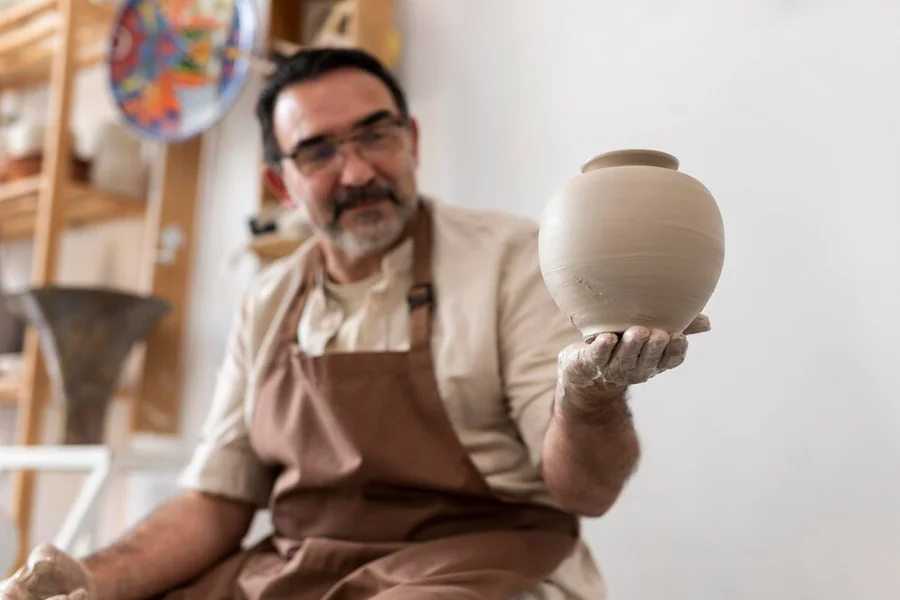
While some simpler forms might use molds as a starting point, the majority of Bolesławiec pottery still involves the time-honored techniques of wheel throwing and hand-forming. Even when molds are involved, human hands are essential throughout the process—adding those crucial finishing touches, carefully attaching handles, and ensuring each piece has the structural integrity it needs.
Watching a skilled potter work is mesmerizing. There’s a rhythm to it, a dance between the artisan and the clay that can’t be replicated by machinery.
The Magic of Decoration
After the pieces receive their white engobe coating, the real artistry begins. The decoration technique, called “stempelki,” involves using small wooden or sponge stamps that are often handmade by the artisans themselves.
An artisan dips a tiny stamp into colored slip and carefully presses it onto the curved surface of a bowl or pitcher. It sounds simple, but it requires incredible skill and artistic sensitivity. Master decorators develop an almost intuitive understanding of how patterns should flow around three-dimensional forms, adapting traditional motifs to complement each vessel’s unique shape.
The most elaborate pieces can incorporate over a dozen different stamps in compositions that take hours to complete. It’s meditative work that demands both technical precision and creative vision.
The Transformation Through Fire
After decoration comes the bisque firing at around 1650°F (900°C), followed by the application of a transparent glaze that protects the decoration and creates that gorgeous glossy finish everyone recognizes.
But the real magic happens during the final high-temperature firing at approximately 2200°F (1200°C). This is where both clay and glaze undergo their complete transformation, coming out as the exceptionally durable stoneware that has made Bolesławiec famous worldwide.
Watching ordinary clay and simple glazes transform into these beautiful, functional pieces that will outlast most of what we own, there’s something almost alchemical about the process.
A Living Tradition That Keeps Evolving
What strikes observers most about Bolesławiec pottery is how it manages to honor its past while embracing the future. In a world that often feels divided between soulless mass production and precious artisanal items that are too special to actually use, these Polish ceramics have found the perfect middle ground.
Contemporary artisans continue to introduce new forms and decorative interpretations, but always within the framework of traditional techniques and motifs. It’s this careful balance—innovation grounded in respect for heritage—that ensures this centuries-old craft remains vibrant and relevant to modern life.
When you look at a piece of Bolesławiec pottery, you see more than just a beautiful object. You see a testament to the enduring value of human skill, cultural continuity, and the simple pleasure of owning something made with genuine care and intention. In our disposable world, that’s becoming increasingly precious.
Whether you’re drawn to these pieces for their stunning beauty, their remarkable durability, or their rich cultural heritage, one thing is certain: Bolesławiec pottery offers something our modern world desperately needs—objects that are both meaningful and useful, created with skill and intended to last.
