
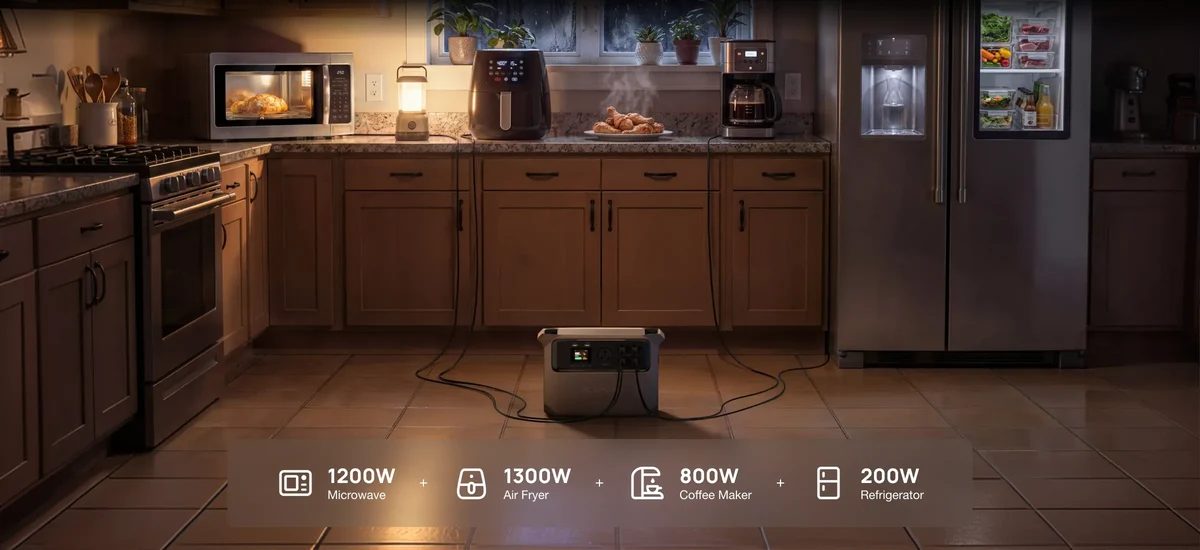

Yes. A portable power station can run a washing machine when its AC supply matches the washer’s voltage and power requirements and its battery holds enough energy to finish the selected cycle. A cold wash is a useful starting point because it avoids deliberately selecting energy-intensive heating or sanitizing functions.
The task is to complete a cycle, not simply make the control panel light up. Filling, agitation, draining, and spinning create changing demands, and the home still needs a working water supply and somewhere for the drain water to go.
Separate the Washer from the Dryer
Begin with the appliance’s supply label. A stand-alone 120V washer and a combined laundry centre with an electric dryer can have very different electrical requirements. Some combined units require 208/240V, so a household-style 120V outlet is not enough even if the battery has ample capacity.
The dryer’s requirements should be evaluated separately. Running a wash cycle does not establish that the same setup can handle electric drying, and an all-in-one machine may introduce substantial heating demand when it changes modes.
For an outage plan, focus on washing an essential load and drying it on a rack or line. That keeps the backup task smaller and avoids buying a much larger electrical system just to complete the drying stage.
Understand What Changes During the Cycle
A washer draws different amounts of power while it fills, moves the drum, pumps water, and accelerates into a spin. The motor and pump also have starting demands that an inverter needs to accommodate.
Water heating is a separate issue. Some washers take hot water from the home’s supply; others have an internal heater used by particular programs. Choosing a hot or sanitizing cycle can therefore change either the washer’s electrical demand or its dependence on the home’s water heater.
A branch-circuit requirement of 15 or 20 amps describes the recommended electrical supply. It should not be treated as proof that the washer continuously consumes that current throughout every cycle.
When comparing a portable power station, look at continuous AC output, starting capability, and energy capacity separately. Avoid relying on a voltage-reducing boost mode to make a washer appear compatible: electronic controls and motors need their intended supply.
Size for Energy per Cycle
For battery planning, accumulated watt-hours over a complete cycle are more informative than one instantaneous watt reading. A suitably rated plug-in energy meter can record a normal cycle while utility power is available.
As a worked calculation, if your chosen program uses 0.35kWh, that equals 350Wh at the appliance. Allowing 85% usable battery energy gives about 412Wh before adding a reserve. A 500Wh station would leave little margin, while a roughly 1,000Wh class unit provides more room. This example addresses energy only; the station must also meet the washer’s output requirement.
Do not use a reading from a quick cold cycle to promise the same result for a heated sanitizing program. Record the program and load you intend to use during an outage so that the result remains relevant.
Before starting, leave enough charge to complete the task. An interrupted cycle can leave a door locked or water in the drum, creating a second problem when the original goal was simply clean laundry.
Check Water and Drainage Before Connecting Power
Backup electricity does not restore water pressure. Homes with a well may also need power for the well pump, and a washer requiring a hot-water connection still depends on that supply arrangement.
Keep the normal drain path available. If a separate sewage lift or drainage pump is needed to remove water from the building, that is another load to address before running the washer.
Place the station on a stable, dry surface outside splash areas and away from appliance movement. Use the grounded connection required by the washer. Avoid improvising an extension arrangement where the appliance instructions require a direct connection.
A trial on the intended power source should include the full cycle, particularly the transition into spinning. Starting successfully and then tripping halfway through is not a successful backup test.
FAQ
Does a Smaller Laundry Load Always Use Proportionally Less Electricity?
No. The controls, pump, and parts of the cycle still operate, and a smaller load does not necessarily shorten every stage. Use the appropriate load setting and program rather than assuming half the clothing means half the energy.
Can You Resume a Cycle After the Battery Runs Out?
The washer’s control logic determines that. It may resume, reset, or require a drain procedure. Do not force a locked door; use the machine’s interrupted-cycle instructions. Planning enough energy to finish is easier than recovering a half-completed load.
Conclusion
A portable power station can be a practical way to complete essential laundry, especially a cold wash followed by air drying. Confirm the supply requirements, use energy per cycle to plan capacity, and include water and drainage in the preparation. That gives you a complete laundry plan rather than an outlet that happens to turn the washer on.
