
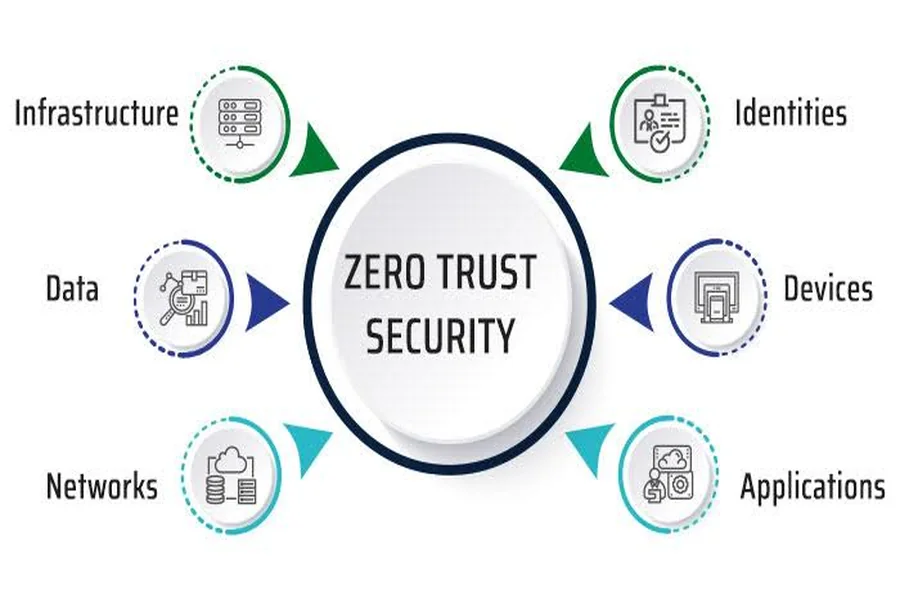

A cloud migration can look controlled on a program board and still become messy at the access layer.
A mid-size financial services firm, for example, may move customer analytics to one cloud, keep payment processing on private infrastructure, adopt several SaaS platforms, and give contractors temporary access from unmanaged locations. The perimeter hasn’t merely shifted. It has split into hundreds of small decisions.
That is where zero trust security earns its place. It replaces location-based confidence with repeated checks on identity, device condition, workload context, requested resource, and current risk.
Scaling it isn’t about buying a single control. It’s about making those decisions consistent across an environment that changes every week.
Start With the Decision Model, Not the Product Map
Teams often begin with tools because tools have owners, budgets, and renewal dates. That’s a common mistake when building zero trust security across cloud environments. The harder work comes first: deciding what evidence must be present before a person, device, service, or workload gets access.
A practical policy should answer five questions:
- Who or what is requesting access?
- Is the device or workload in an acceptable state?
- Which resource is being requested?
- What level of access is justified right now?
- What event should trigger re-evaluation or termination?
This is the operating logic behind modern zero trust security infrastructure. Write that logic in plain language before translating it into identity rules, network policy, cloud controls, and detection workflows. Otherwise, different teams will encode different meanings of “trusted,” and audit meetings will expose the gaps.
Build an Inventory That Reflects Runtime Reality
Cloud inventories decay quickly. Effective zero trust security depends on knowing exactly which identities, workloads, and services exist at any given moment.
A configuration database may show approved applications, yet miss short-lived containers, service identities, test environments, API connections, and abandoned storage. Static records alone won’t carry a scaled program.
Connect Ownership to Discovery
Combine cloud-native discovery, identity directories, endpoint data, network telemetry, and application records. Every important asset needs a business owner, technical owner, sensitivity rating, and expected communication path. Treat unknown ownership as a finding, not an administrative inconvenience.
The UK’s National Cyber Security Center makes asset knowledge its first zero trust architecture design principle.
That ordering matters. If the security team can’t see a workload or service account, it can’t apply a meaningful access decision to it.
Include Machine Identities Early
Human access usually gets attention first. Machine-to-machine access is where scale becomes awkward.
Service accounts, automation runners, functions, containers, and APIs can make thousands of access requests without any involvement. Give each of them an identity. Limit their permissions to what they need. Use credentials that don’t last long. Keep records of how they depend on other systems. Shared secrets hidden in files are a big risk, but having too many permissions for service accounts can cause just as much harm.
Standardize Policy Across Clouds Without Flattening Context
Should every cloud use identical policy? Not exactly.
The policy intent should be common, while enforcement can respect the platform. Consistency is one of the hardest challenges in scaling zero trust security.
A rule such as “production database administration requires a managed device, strong authentication, approved role, and recorded session” can remain stable even when the technical control points differ.
Forcing every platform into one brittle implementation often creates exceptions, and exceptions quietly become the real architecture.
Create a policy hierarchy:
- Enterprise principles define non-negotiable access conditions.
- Resource classes set requirements by sensitivity and business impact.
- Platform controls translate those requirements into local enforcement.
- Temporary exceptions carry an owner, expiry date, and compensating control.
Keep policy in version control where possible. Peer review it. Test changes against representative traffic before release, because one badly scoped denial rule can interrupt revenue systems faster than a traditional firewall change.
Treat Segmentation as Damage Control
Identity checks don’t remove the need for segmentation. In mature zero trust security programs, segmentation limits the blast radius when credentials or workloads are compromised. They make segmentation more precise.
Break access paths around applications, workloads, data sensitivity, and operational purpose rather than broad network zones. A payroll application shouldn’t accept lateral connections simply because the source sits inside the same virtual network. Nor should a compromised developer identity provide a clean route into production.
Start with high-consequence paths: privileged administration, backup systems, identity services, production data, and management planes. Observe normal flows before enforcing tighter rules. Then move from visibility to alerting, limited enforcement, and full enforcement. Big-bang segmentation looks decisive in slides. During an incident review, it often looks reckless.
Make Telemetry Part of Access, Not an Afterthought
At scale, access policy needs fresh signals. Device health, impossible travel, token behavior, workload changes, unusual data movement, and failed privilege attempts can alter the decision after a session begins.
This is where SOC and architecture teams must share definitions. If “high-risk device” means one thing in endpoint tooling and another in cloud access policy, automation will behave unpredictably. Agree on signal owners, severity, freshness, and the response attached to each state.
This model works by linking identity, the state of a device, and access to applications, enforcing rules on the network and security information across types of environments. The important question is not if a platform has a zero trust label. It is whether its controls can share information fast to stop a session, move a device to a safe area, or ask for new login details without waiting for a help desk request.
Operational maturity matters too. Teams developing their analysts may find this overview of cybersecurity courses for threat detection and security operations useful when mapping skill gaps around investigation, telemetry, and response.
Measure Outcomes That Survive a Budget Meeting
Counting deployed agents or written policies says little about reduced exposure. Better measures connect architecture work to business risk:
- Percentage of privileged access using time-limited approval
- Coverage of unique identities for users, devices, and services
- Number and age of policy exceptions
- Time to revoke access after a risk-state change
- Reachable critical assets from a compromised test identity
- Failed access attempts blocked by context, not location alone
Run tabletop exercises and controlled attack-path tests. Ask whether a stolen credential can reach sensitive data, whether a compromised workload can move sideways, and how quickly the SOC can explain the decision trail. Those answers persuade finance and audit teams far more effectively than a deployment count.
Scale the Control System, Not Just the Control Set
Cloud growth exposes inconsistency. One team grants standing privileges, another uses temporary access, and a third doesn’t know which service identity owns a production connection. Adding more enforcement points won’t fix that by itself.
Scaled zero trust security depends on a shared decision model. It depends on live asset knowledge. It depends on machine identity discipline. It depends on policy. It depends on segmentation. It depends on telemetry that can change access while activity is underway. The work is incremental. The work is occasionally untidy. Still, each improvement should make one outcome more likely. When an identity is compromised, the attacker finds paths.
When a workload is compromised, the attacker finds paths. When an identity is compromised, the attacker gains authority. When a workload is compromised, the attacker gains authority. When an identity is compromised, the attacker stays visible for a time. When a workload is compromised, the attacker stays visible for a time.
