
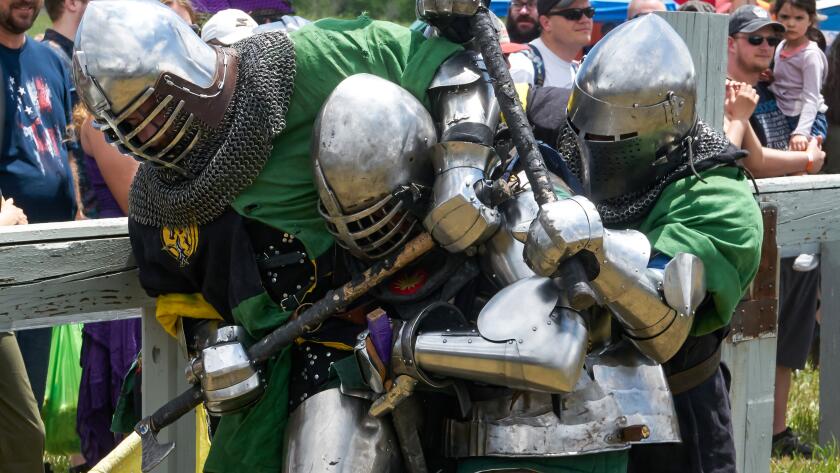

The contemporary buhurt and armored fight require that the equipment endure long and hard impacts as well as provide protection to the fighters, facilitate fair play, and ensure adherence to ethical production practices. Medieval Extreme utilizes the well-informed combat craftsmanship, which has the criteria of the tournaments, sparring sessions, and training exercises as the starting point for the design and materials selection. Each armor, weapon, and shield passes through the process of re-evaluation several times, each time weighing the factors of impact absorption, articulation, and compliance with the rules.
What “Combat-Informed Craftsmanship” Means
Combat-informed craftsmanship is the deliberate and scientific method of field data measurement in gear design to the point of refinement. The main technical principles are as follows:
- Quantification of impacts: Armor parts undergo testing whereby they are made to take up to hundreds of strikes with the highest forces being measured at 100-300 N/cm² for gauntlets and 250-600 N/cm² for torso protection.
- Monitoring of wear: The process of making blades or armor is monitored over a given number of impacts (100-500) to determine fatigue, spring-back, and stress distribution.
- Articulation optimization: Joint plates are designed with enough spacing of 3-5 mm to allow for movement but still maintain overlap during high-force strikes.
- Mass distribution analysis: The balance of helmets, shields, and swords is done using metrics of head, grip, and balance-point to prevent rotational torque and thus accumulating strain on fighters.
This method turns subjective criticism into quantifiable design parameters, leading to reproducible safety enhancements.
From Feedback to Iteration: the Product Improvement Cycle
Medieval Extreme follows a rigorous testing and iteration process:
- Field observation: Quantitative data on strikes, parries, and fatigue are obtained through high-speed video, force sensors, and wearable accelerometers. For example, a helmet can have a maximum linear acceleration of 50 g during a tournament fight in a regular way.
- Analysis and reporting: Comparison of performer’s capabilities with the restrictiveness of the steel thickness and the padding compression (up to 10-20 mm foam layers), and the chainmail flexibility (link diameters 6-8 mm, and yield strength >350 MPa) respectively.
- Prototype adjustments: Adjusting the thickness, liner materials, or balance points by ±1-2 mm or ±50-100 g to produce less fatigue and improve impact control.
Each change will not only be subjected to re-testing for its repeatability but also will be confirmed to be the right ones for consistent and comparable improvements across all fighter categories.
Data-based iteration leads to a significant reduction of untested assumptions and an increase in safety outcomes as a result.
Safety-First Design Choices and Why They Matter
The measures implemented are primarily concerned with safety, and the numeric values set by human tolerance combined with the regulations are the bases for these measures:
- Joint articulation: The plates have an overlap of 3-5 mm with secure rivet spacing to ensure that no part is exposed but the range of motion is not affected.
- Weapon parameters: The sword can be of 1.2-1.6 kg mass, 90-100 cm in blade length, and can be flexed 10-15° without permanent deformation so as to avoid injuries caused by accidental overreach.
All the safety requirements come from the measured human biomechanical tolerances and restrictions imposed by the tournament rules.
Ethics: Materials, Labor, and Honest Specs
Technical specifications embrace ethical considerations:
- Material sourcing: The deployment of steel that is tensile strength-certified (>700 MPa) and with traceable origin decreases the chances of being involved with environmental and worker issues.
- Labor practices: The personnel engaged in the assembly and the finishing are operating under documented conditions that ensure quality control and reduction of variability in the performance of the armor.
- Transparent specifications: All products come with published information about their precise weight, blade thickness, liner depth, and balance point, which allows fighters to evaluate their gear objectively before purchase.
Ethical practices are not an alternative; they are quantifiable, verifiable, and crucial for the trust of the community, values also reflected by unitedwesternwear in their approach to quality and responsibility.
Community Impact: Supporting Teams, Events, and Newcomers
Combat-informed gear design impacted the strengthening of community structures:
- Team-related setups: The basic weapons of shields, halberds, and swords have been redefined according to the composite metrics of the team’s strategies such as the reach, spacing, and arc of strike.
- Event feedback loops: The first data for each product improvement is the quantitative report generated during every competition containing the figures of strikes, armor deformation, and fatigue patterns.
- Beginner support: Training shields and armor having 3-6 kg weight and rounded edges with adjustable straps designed in a way that learners, who might get hurt in the process, would receive the necessary support during the learning curve.
The method that is measurable and iterative not only of the elite but also the fresh fighters are able to participate safely while the competition remains fair.
How to Judge Any Brand’s Credibility: Transparency Checklist
The technical verification of a manufacturer guarantees safe and ethical production through assessment:
- Published numeric specs: The mass, blade length, steel thickness, liner depth, and balance points must be listed for every product.
- Testing documentation: Evidence of impacts, articulation, and fatigue tests under measurable loads done multiple times.
- Iteration history: Documentation of product development using quantified field feedback.
- Community engagement: Transparent reporting of changes, user-tested results, and adherence to competition rules.
- Material and labor trackability: Authenticate quality certification of steel, tensile strength, and labor practices.
Manufacturers that meet the above-mentioned standards provide data-backed guarantees of safety, justice, and ethical standards.
Fighter Action Step
Before making a choice between a buhurt armory and a buhurt weaponry:
- Heat the thickness of helmet and armor, the depth of the liner and the tolerances for articulation.
- Confirm that swords and shields meet the specifications for mass, balance, and flex.
- Make sure that repeated impact tests have been conducted and that the results are documented.
- Look at the sources of materials, labor standards, and transparency in specifications.
Compare the product performance metrics against the rules of competition and the human biomechanical limits.
Thus, it is ensured that the fighters receive safe, ethical, and competition-ready gear supported by quantified performance data rather than marketing claims, alongside additional insights that can be explored through wikimitra.
