
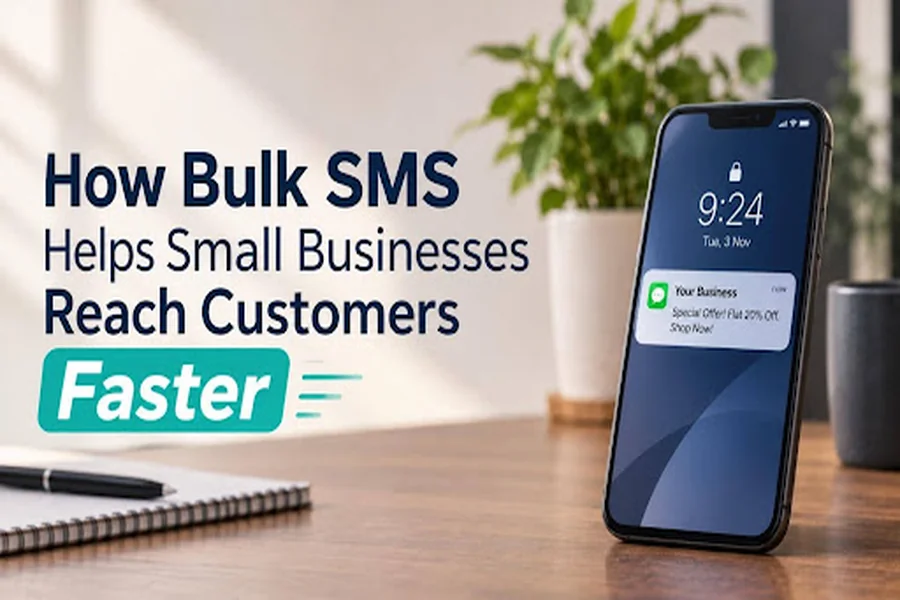

Small businesses rarely lose customers because the product is bad. More often the message arrives late: the sale announcement shows up after the weekend, nobody confirms the appointment, or a lead goes cold waiting for a callback.
Bulk SMS helps with that timing problem. A shop, clinic, coaching centre or online store can send the same text to hundreds or thousands of people at once, and most of those texts get read within minutes.
Why speed matters more for small businesses
Large brands can buy attention with big ad budgets and repeat campaigns. A small business often gets one chance to reach a customer at the right moment. A bakery that sells out of fresh stock by 4 PM, a salon with a last-minute cancellation, or a local electronics store clearing festive inventory all have offers that lose value within hours.
Email and social media both come with a delay. Emails can sit unopened in a promotions tab, and a social post only reaches the people an algorithm decides to show it to. A text lands on the phone’s lock screen as soon as it is sent, so the business decides when the customer finds out.
Why people read text messages so quickly
The engagement numbers for SMS need careful reading. A 2022 report on text messaging from the US FCC’s Consumer Advisory Committee estimated SMS open rates at up to 98% and response rates at up to 45%, against roughly 20% opens and 6% responses for email. The SMS figures are upper limits, so a typical campaign will land below them, but the gap with email is still wide.
Habit explains a lot of it. People check texts almost by reflex, since texts have long come from family, banks and delivery services. SMS also needs no app, login or internet connection. In India, where many customers still use basic phones or have patchy mobile data, that reach counts for a lot.
What bulk SMS covers
Bulk SMS is business messaging sent to many recipients at once through an SMS gateway. In India it falls into three types. Promotional SMS carries offers, discounts, new arrivals and event announcements to customers who have agreed to receive them. Transactional SMS covers OTPs, order confirmations, payment receipts and bank alerts that a customer needs to complete an action. Service SMS handles delivery updates, appointment reminders and account notifications for existing customers.
Each type has its own rules on delivery, timing and consent, so work out which one you are sending before you plan a campaign.
Five ways bulk SMS gets you to customers faster
1. Instant confirmations
When a customer pays online or books a slot, they want proof straight away. A transactional SMS service sends order confirmations, OTPs and receipts within seconds, including at night and on holidays. Customers stop calling to ask whether their payment went through, and a small business comes across as dependable as a much larger one.
2. Offers that arrive while they still count
A three-hour flash sale only works if customers hear about it in the first hour. A short promotional text with a clear deadline and a single link puts the offer in front of your list before the window closes.
3. Fewer no-shows
Clinics, salons, repair services and tutors lose money on every empty slot. A reminder the day before, with an easy way to confirm or reschedule, gives you time to fill a cancellation instead of discovering it when the customer doesn’t turn up.
4. Faster lead follow-up
When someone fills in an enquiry form, the first business to reply usually has the best chance of winning them. An automated text that thanks them and gives a direct contact number keeps the lead warm until someone can call.
5. Updates to everyone at once
Changed opening hours, a delayed delivery batch or an early festival closing can reach your whole customer list in one send. That saves hours of phone calls and spares customers a wasted trip.
Getting compliance right in India
Fast sending is useless if messages don’t get delivered, and in India delivery depends on following TRAI’s rules. Every business sending commercial SMS, including OTPs and transactional alerts, has to register on a DLT (Distributed Ledger Technology) platform run by a telecom operator. That means registering your business as a principal entity, your sender ID (header) and each message template.
Two more recent rules are worth knowing. Since 6 May 2025, operators add a suffix to every business sender header (-P for promotional, -S for service, -T for transactional, -G for government) so recipients can see what kind of message they have received. Any URL or callback number in a message must also be whitelisted on the DLT portal first, or the message can be blocked. A good provider helps you through these steps.
Choosing the right provider
SMS gateways vary in performance. Before signing up, check the delivery rate on transactional routes, how quickly the provider helps with DLT template approval, whether it has an API for your website or billing software, and whether its reports separate delivered messages from failed ones instead of only showing “sent.” Comparing a few bulk SMS service providers in India on these points before you commit will save trouble later.
Practical tips for better results
Keep each message short, with one clear action. Send during sensible hours: late-morning messages tend to get quicker replies, and promotional SMS in India is limited to certain time windows anyway. Use the customer’s name or last purchase where you can, so the message reads like it came from a business they know.
Watch your frequency, because over-messaging is one of the quickest ways to lose subscribers. Use short links or unique codes to track which messages led to visits, bookings or sales.
Frequently asked questions
Is bulk SMS expensive for a small business?
Per-message costs are low, and most providers sell credit packs, so you can start small and scale up once you see results.
Can I send bulk SMS in India without DLT registration?
No. Telecom operators filter out commercial messages from unregistered entities, headers or templates.
Is SMS better than WhatsApp for business?
They suit different jobs. SMS reaches any phone without an app or data connection, which makes it more dependable for OTPs, alerts and customers in areas with poor internet.
Final thoughts
For a small business, the main advantage of bulk SMS is that the message reaches the customer while it can still change what they do. Register on DLT properly, choose a provider with strong delivery on the routes you need, and keep messages short and relevant. Done that way, SMS is one of the cheapest channels a small business has for staying in touch with customers.
