


Modern web development moves fast. Teams ship hundreds or thousands of code commits monthly through CI/CD pipelines. Manual QA can’t keep up. Picture a team running 50-100 tests daily trying to validate 2,000 regression test cases. That cycle takes weeks. Your CI/CD pipeline needs answers in hours.
Test automation has changed completely. Selenium used to dominate, requiring developers who could write complex scripts. Now AI runs the show. Self-healing tests fix themselves when your UI changes. Element recognition hits 99%+ accuracy. Business analysts create tests without writing code, using visual builders or plain English commands.
Five platforms stand out in 2025-2026. Functionize brings 99.97% element recognition accuracy through agentic AI. ACCELQ and Opkey slash test creation time by 80-95% with codeless interfaces. Panaya and Opkey handle specialized SAP/ERP testing across 12+ packaged applications. HeadSpin provides real devices in 50+ locations tracking 130+ performance KPIs. These solutions range from vendors founded in 2014-2015 to platforms serving 200-250+ global enterprises, all tackling test maintenance overhead and flaky test reduction.
How to Evaluate Automated Testing Platforms
Our December 2025 research assessed platforms across AI/ML strength, non-technical user accessibility, maintenance efficiency, and enterprise features. Five criteria guided evaluation:
- AI/ML Intelligence & Self-Healing: Element recognition accuracy from 95-99.97%, self-healing technology fixing tests automatically when locators change (cutting maintenance 80%), ML-powered test generation, and NLP creating tests from plain English
- Codeless/Low-Code Capabilities: Visual builders, drag-and-drop interfaces, record-and-playback tools, natural language commands, and reusable components enabling business analysts and manual testers to automate without programming
- Test Maintenance Efficiency: Self-healing scripts, automatic UI change adaptation, smart alerts for major application updates, impact analysis showing which tests need updates, targeting 70-95% maintenance reduction
- CI/CD Integration & Scalability: Native connections to Jenkins, Azure DevOps, GitLab, GitHub Actions, test triggering on commits/builds/deployments, parallel execution scaling to thousands of concurrent tests, cloud infrastructure, API access
- Specialized Capabilities & Coverage: Support for SAP/ERP systems, packaged applications, mobile apps, APIs, databases, global device infrastructure, performance monitoring with 100-130+ metrics, cross-browser testing, industry solutions
List of the Best Automated Testing Platforms
These five platforms combine AI intelligence, codeless test creation, and deep CI/CD connections for web application testing in 2025-2026.
- Functionize
- ACCELQ
- Panaya
- HeadSpin
- Opkey
Top Automated Testing Platforms for Web Applications
1. Functionize
- Founded & Location: 2014 (some sources cite 2015), headquartered in Walnut Creek, California (formerly San Francisco), with London office for European operations
- AI/ML Technology: 99.97% element recognition accuracy powered by 8 years of enterprise training and 30,000+ data points per page; agentic AI builds, runs, diagnoses, and self-heals tests end-to-end
- Self-Healing & Maintenance: Reduces flaky tests and maintenance by 80% through advanced self-healing technology that detects and fixes issues automatically
- Test Creation Speed: Non-technical teams can create and deploy tests 90% faster than traditional scripting approaches (from idea to execution in minutes, not hours/days)
- CI/CD Integration: Native integrations with Jenkins, Azure DevOps, GitLab, Jira, PagerDuty, Xray; supports 60+ test automation frameworks; stateless containerized agents scale to thousands of concurrent tests
Functionize started in 2014 as an enterprise AI test automation platform serving global organizations from Walnut Creek, California. Agentic AI agents build, execute, diagnose, and maintain tests independently with minimal human input. The 99.97% element recognition (trained on 30,000+ data points per page) eliminates brittleness found in traditional Selenium testing. NLP lets business analysts and manual testers create complete automated workflows in plain English within minutes, no coding required.
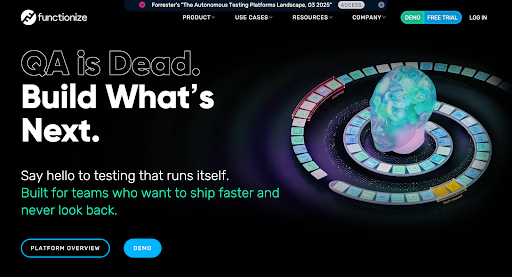
Best For: Enterprises seeking highest AI intelligence (99.97% element recognition) with minimal maintenance burden (80% reduction in flaky tests)
Standout Feature: Industry-leading 99.97% element recognition accuracy powered by 8 years ML training plus 80% reduction in test maintenance through agentic AI self-healing
2. ACCELQ
- Founded & Location: 2014, headquartered in Dallas, Texas, with offices in San Francisco, California; founded by Mahendra Alladi (CEO)
- Codeless Platform: AI-powered codeless test automation for web, mobile, API, database, desktop, and packaged applications; unified platform eliminating need for multiple tools
- Business User Accessibility: Enables non-technical users (business analysts, product owners, manual testers) to build tests using visual flows, drag-and-drop components, and natural language-like instructions
- Productivity Gains: Delivers 3x productivity improvement and 70%+ cost savings compared to traditional code-based automation; recognized as leader in Forrester Wave™ Continuous Automation Testing Platforms Q4 2022
- DevOps Integration: Seamless connections with Jenkins, Azure DevOps, GitHub Actions; cloud-native architecture supporting role-based access control for team collaboration
ACCELQ launched in 2014 as a cloud-based codeless automation platform operating from Dallas, Texas. One unified approach covers web, mobile, API, database, desktop, and packaged application testing, removing the need for multiple specialized tools. AI-powered maintenance adapts tests to application changes without manual work. Codeless test creation through intuitive visual flows and natural language commands lets business analysts and product owners without programming backgrounds build sophisticated test scenarios, achieving 3x productivity gains over traditional Selenium methods.
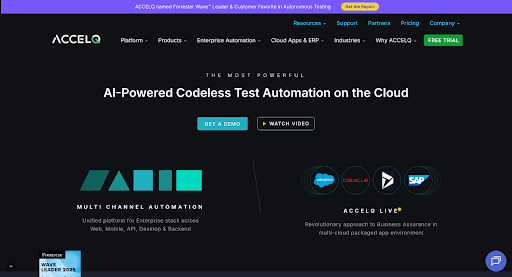
Best For: Organizations seeking unified testing platform (web + mobile + API + database + desktop) with strongest codeless capabilities for non-technical users
Standout Feature: Forrester Wave™ leader (Q4 2022) delivering 3x productivity and 70%+ cost savings through AI-powered codeless automation across all application types
3. Panaya
- Founded & Specialization: SAP testing specialist (exact founding year not specified in sources); operates as SaaS-based test management leader; partnership with Tricentis for autonomous SAP testing platform
- SAP/ERP Focus: #1 solution for SAP testing supporting SAP Fiori apps, classic SAP GUI, SAP Cloud ALM integration, and cross-system coverage (SAP and non-SAP applications)
- AI-Powered Automation: Codeless/low-code SAP test automation requiring zero programming skills; users record actions and replay across test cycles; AI-driven change impact analysis and autonomous test generation
- Enterprise Testing Features: Real-time reporting dashboards, automatic test evidence generation for audit compliance, collaborative UAT (user acceptance testing) tools, defect management, requirements traceability
- Test Cycle Reduction: Customers achieve up to 50% reduction in test cycle time; platform integrates test management, change impact analysis, and AI-powered automation in single native platform
Panaya operates as the leading SaaS-based test management solution specializing in SAP/ERP environments, partnering with Tricentis for autonomous testing. SAP specialization tackles unique enterprise resource planning testing challenges. Autonomous test generation uses machine learning to observe real user interactions and automatically create business process tests. AI-driven change impact analysis identifies which processes need regression testing after SAP updates. Codeless automation lets business users without programming skills record SAP workflows and replay them across test cycles, with automatic audit-ready documentation capturing every execution step.
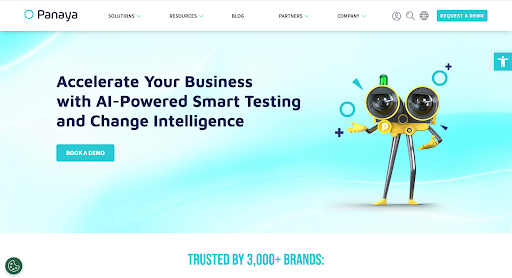
Best For: SAP/ERP organizations requiring specialized testing solution with AI-powered change impact analysis and autonomous test generation
Standout Feature: #1 SAP testing solution achieving 50% test cycle time reduction through AI-powered autonomous testing with SAP Cloud ALM integration
4. HeadSpin
- Founded & Infrastructure: Digital Experience AI Platform (founding year not specified in sources); global device infrastructure with real SIM-enabled devices across 50+ locations worldwide
- Device Testing Coverage: Supports mobile devices, desktop browsers, OTT media devices, Smart TVs, automotive devices; cloud and on-prem deployment options; real-world testing with SIM-enabled connectivity
- AI-Driven Performance Analytics: 130+ built-in KPIs covering UI, network, device, and experience metrics; AI-powered root cause analysis, issue cards with impact time analysis, experience monitoring without RUM
- Automation Framework Support: Integrates with 60+ test automation frameworks including Appium, Selenium, XCUITest, Espresso, enabling teams to use existing test scripts on global device infrastructure
- Enterprise Benefits: Reduces mean time to identify/resolve issues during test, QA, and production; supports continuous monitoring using synthetic data; comprehensive QoE (Quality of Experience) analytics for audio/video testing
HeadSpin operates as the first Digital Experience AI Platform combining global real-device infrastructure, test automation, and ML-driven performance analytics. Global device infrastructure spans 50+ locations with thousands of real SIM-enabled devices, enabling testing under actual network conditions (carrier networks, 5G, edge cases) impossible to replicate in emulators or simulators. AI-powered analytics tracking 130+ KPIs automatically surface performance bottlenecks and root causes across all layers, from quantifying audio/video quality of experience to code-level and packet-level visibility, while supporting 60+ automation frameworks (Appium, Selenium, Espresso, XCUITest).
Best For: Organizations requiring real-world device testing across 50+ global locations with comprehensive performance monitoring (130+ KPIs) and QoE analytics
Standout Feature: Only platform combining global real SIM-enabled device infrastructure (50+ locations) with AI-driven 130+ KPI tracking and 60+ automation framework support
5. Opkey
- Founded & Location: 2015, headquartered in Dublin, California, with offices in Pittsburgh, New York City, India, Australia; founded by Pankaj Goel, Avinash Tiwari, and Lalit Jain
- No-Code ERP Platform: Industry-leading no-code test automation for 12+ packaged applications and 150+ technologies including Oracle, Workday, Coupa, Veeva, SAP, UKG; #1 rated app on Oracle Cloud Marketplace
- Test Creation Speed: Enables business and technical users to automate application testing 95% faster than Selenium or code-based tools; creates tests in hours, not months
- AI-Powered Features: Test Discovery technology mines process logs to identify which processes need testing; ML algorithms discover legacy tests and identify coverage gaps; Natural Language Processing chatbot (Wilfred) executes tests via written commands
- Enterprise Adoption: 250+ global enterprise customers; partnerships with KPMG LLC and PwC; $47M Series B funding (2024); reduces test maintenance efforts by 80% through self-healing scripts
Opkey started in 2015 from Dublin, California as a no-code continuous testing platform now serving 250+ global enterprises including KPMG and PwC partnerships. ERP specialization supports 12+ packaged applications (Oracle, Workday, SAP, Coupa, Veeva, UKG) and 150+ technologies through truly codeless automation. Any employee creates automated tests 95% faster than Selenium by mimicking day-to-day workflows, with smart recorders automatically capturing test data, keywords, and object properties. AI-powered Test Discovery analyzes process logs to identify which business flows actually require testing, eliminating thousands of hours manually documenting workflows, while self-healing scripts reduce maintenance effort by 80%.
Best For: ERP/packaged application testing (Oracle, Workday, SAP, Coupa) requiring no-code platform enabling any employee to create tests 95% faster
Standout Feature: #1 Oracle Cloud Marketplace app supporting 12+ ERP systems with AI-powered Test Discovery and 95% faster test creation serving 250+ enterprises
Factors to Consider When Choosing Automated Testing Platforms
Balance AI Intelligence with Team Technical Capabilities
Platforms range from advanced AI to fully codeless tools. If your team has automation engineers, pick something that allows both visual building and deeper customization. If your team is mostly non-technical, choose a truly codeless option that business users can run. Make sure the AI can handle UI changes without constant manual fixes.
Evaluate Application-Specific Requirements
Different applications need different strengths. ERP suites often require process-aware testing and support for complex transactions. Mobile testing should include real devices, not just simulators. If you test many types (web, mobile, API, database, packaged apps), a unified platform can reduce tool sprawl. Confirm it supports your exact frameworks, APIs, databases, and system versions.
Calculate Total Cost of Ownership Beyond License Fees
Pricing models vary a lot, so look past the sticker price. Factor in infrastructure, onboarding, services, and ongoing support costs. Estimate ROI using time saved on test creation and, especially, maintenance. Use a trial to validate results before committing.
Assess CI/CD Integration Depth and Deployment Flexibility
Triggering tests is the minimum—deep integration means clear reporting, automatic failure rules, and parallel runs. Check that your CI/CD tools are supported out of the box. Decide whether cloud, on-prem, or hybrid fits your security and compliance needs. Strong APIs also help when you need custom workflows.
Final Thoughts
Testing automation has shifted from code-heavy frameworks to AI platforms that let more teams build and maintain tests. Choose a tool that matches your apps and team. Prioritize self-healing and maintenance reduction (maintenance can be 40–60% of effort). Run a real-world trial to confirm accuracy, CI/CD fit, and usability, and plan 2–4 weeks for onboarding. Modern platforms now support both strong regression coverage and fast releases.
