
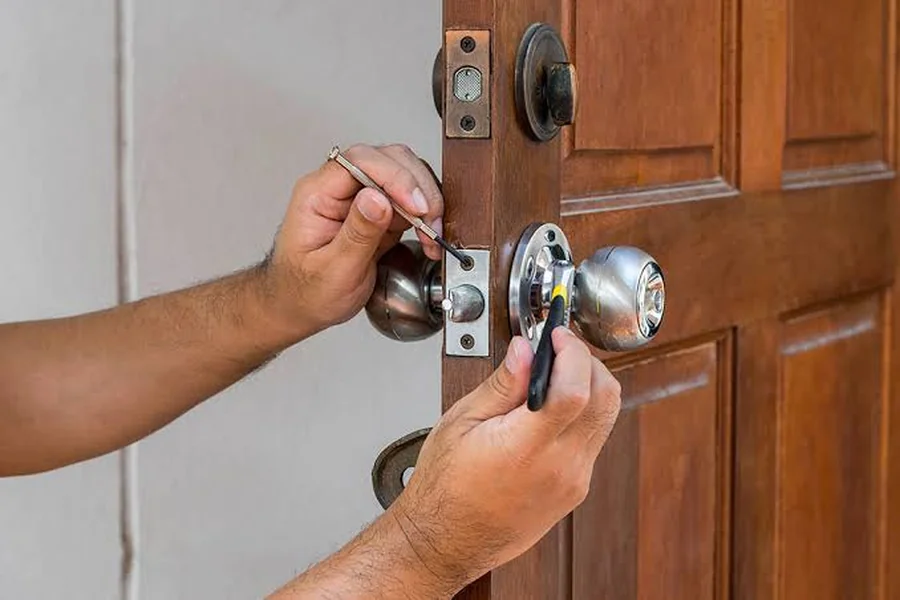

Many homeowners operate under the belief that their door’s lock is adequate protection against potential intruders simply because it looks sturdy. It may not have crossed their minds that the lock could easily be picked, but most front door locks are so basic that any burglar could get through it with a tension wrench or a bump key in less than twenty seconds. A solid deadbolt is the easiest defense against these common methods – as long as it’s installed properly. Sticking with the hardware store’s included strike plate is typically a mistake. Their half-inch screws bury into the softer wood of the frame instead of latching securely into the studs your home is built on, and can be kicked right out of place.
Your Key Sticks, Jiggles, Or Needs A Second Turn
This warning sign is often overlooked, as people tend to brush it off as a minor annoyance, but it’s actually one of the most dangerous red flags. A lock that you need to wiggle, push, or lift the key while turning the cylinder is a lock with worn internal parts, and while those same worn parts make it harder to open the bolt without the correct key, they also make it easier to open with the wrong key or a lock pick.
You Can’t Account For Every Key That Exists
Consider any individual who has had access to your living space. The previous owner, a maid, a maintenance person who repaired the boiler, a relative who left a couple of years back. Retail lock systems use pin and tumbler technology which can easily be replicated at virtually any home improvement store without the necessity of providing identification, retaining records, and without your knowledge. If you have recently changed your residence, the lease has expired, or you provided keys which were not returned, you haven’t really decided who is not allowed to enter your living space. This is not just a risk you are contemplating – it is a clearly defined flaw in how basic home locks are manufactured.
Break-Ins Are Happening On Your Street
When a house on your block gets hit, it’s not usually an isolated event. Thieves tend to work their way down a street or around a block for a few weeks, figuring out which homes offer easy access and which give them trouble. Standard retail deadbolts generally aren’t rated to resist bumping or sustained prying, making them easier to force than they should be just as more break-ins occur in your area. Then, if two or more of the signs on this list match your house, your best option is to contact a qualified scec locksmith to professionally check your entry points and recommend the right security grade that fits your situation and budget, rather than making an uninformed decision about what upgrade to make. That’s the point where a self-check should turn into a professional assessment instead of a weekend hardware store trip.
The Door Flexes Even Though The Deadbolt Is Locked
Push against your locked door near the strike plate. If the door or frame gives even slightly, you’ve found a structural weak point that no cylinder upgrade will fix on its own. A high-grade lock mounted into a thin strike plate or a soft, unreinforced jamb is still vulnerable to a kick-in or pry-bar attack because the failure point isn’t the lock itself, it’s the hardware holding it to the frame. This is one of the most common reasons a “good” deadbolt still fails in a break-in: the door looked secure, but the frame around it wasn’t built to absorb force.
The Lock Has Been In Service For Seven Years Or More
Mechanical locks will degrade with use, that’s just a fact. Springs will wear out, cylinder plugs will become loose, and the keyway will expand slightly. Plus, there’s corrosion and galvanic reaction to consider. So, a lock that is suitable for every scenario is only a pipe dream. But, cylinders and other components can wear out faster if a lock is put to work in an application for which it clearly wasn’t designed.
What To Do Once You’ve Spotted The Signs
Evaluating these five clues will come in well ahead of any assessment on lock grade or key control. These five signs are the first place to look.
1. Cylinders become difficult to turn, either initially or when halfway through. In either case, your lock has begun to break from stress and metal fatigue. You can’t secure your home with a broken lock.
2. You cannot account for all the keys that have been made or used on your lock. A casual or enforced rekey would be the only sensible option.
3. The last house that was robbed in your neighborhood suffered entry via its front door. Look it up from police records or the news, or ask around. If there’s no evidence, this particular clue has no importance, but otherwise, you could usefully learn from the misfortune of others.
4. Doors are made to fit in holes of a certain size and shape. If your door does not fill its hole with a slight, even margin, then it’s loose and a weak point in the structure. A door’s integrity is only as good as the frame in which it is mounted. An inadequately supported lock won’t keep it attached to an unsupportive wall.
5. Home security products age rapidly because what triggers their decline is not so much time as wear and changes in the ways they are used and attacked. Old or untreated locks become easier to misuse as they get older.
A door is only as strong as its weakest component, and that’s rarely the part people think to check first.
None of these five signs need to appear together before you act. Even one is worth a closer look, and if two or more match, that’s your cue to stop guessing and get a professional in. A lock that sticks, a key you can’t fully account for, a soft strike plate, a flexing frame: these are all quiet failures that don’t announce themselves until the night someone tests them on purpose. The good news is that every one of them is fixable, usually for far less than the cost of what a break in actually takes from you.
