
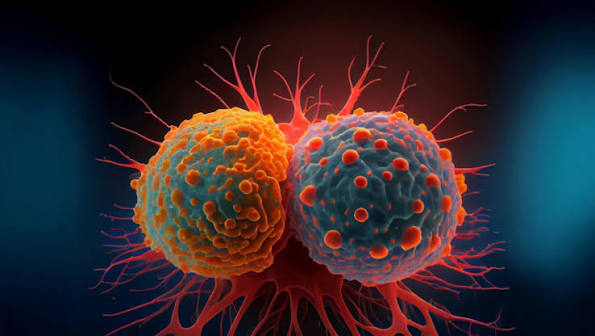

For many years, cancer research focused primarily on what happens inside individual cells. Scientists searched for genetic mutations, abnormal proteins, and disrupted signaling pathways that caused uncontrolled growth. Those discoveries remain essential, but researchers now understand that cancer cannot be fully explained by looking at one cell at a time.
Cancer behaves more like a community than an isolated population of abnormal cells. Every tumor contains a network of cancer cells, immune cells, blood vessels, fibroblasts, and other supporting tissues. These cells constantly exchange information through chemical signals, proteins, and tiny particles. This ongoing communication influences how tumors grow, spread, and respond to treatment.
Understanding this cellular language is becoming one of the most important areas of modern cancer research.
Tumors Are More Than Cancer Cells
A tumor is often described as a mass of cancer cells, but that description leaves out much of the story.
Within every tumor are many different types of healthy and abnormal cells working together or competing with one another. Immune cells attempt to recognize threats. Fibroblasts help build and remodel surrounding tissue. Blood vessels deliver oxygen and nutrients. The extracellular matrix provides structural support.
Cancer cells interact with every one of these components.
These conversations determine whether tumors remain contained, become invasive, attract blood vessels, or develop resistance to therapy. The surrounding environment is not simply reacting to cancer. It is actively influencing its behavior.
This broader view has changed how researchers approach the disease.
Cells Are Constantly Sending Messages
Cells communicate using many different methods.
Some release signaling molecules that travel short distances to nearby cells. Others send hormones through the bloodstream to affect distant tissues. Cells can also communicate through direct physical contact or by releasing microscopic particles known as extracellular vesicles or exosomes.
These messages contain proteins, RNA molecules, lipids, and other biological materials that influence the behavior of recipient cells.
A single message may encourage growth, reduce inflammation, activate immune responses, or promote tissue repair.
Cancer cells use these same communication systems, but they often manipulate them for their own benefit.
Instead of supporting healthy tissue function, they create signals that encourage survival and expansion.
Cancer Learns to Control Its Environment
One of the remarkable abilities of cancer cells is their capacity to reshape their surroundings.
Rather than adapting passively to the environment, tumors actively modify it.
Cancer cells release signals that stimulate new blood vessel formation, ensuring a greater supply of oxygen and nutrients. They recruit fibroblasts that remodel surrounding tissue and make invasion easier. They produce molecules that suppress immune activity, reducing the body’s ability to eliminate abnormal cells.
Through these interactions, tumors gradually create an environment that supports continued growth.
This process demonstrates that successful cancer progression depends not only on changes within cancer cells but also on effective communication with neighboring cells.
The Immune System Listens and Responds
The immune system plays a central role in cellular communication.
Under normal circumstances, immune cells identify damaged or abnormal cells and eliminate them before they become dangerous. Cancer, however, has evolved sophisticated ways to interfere with this process.
Tumors release signals that attract immune cells capable of suppressing protective responses. Some cancer cells produce proteins that prevent immune cells from recognizing them as threats. Others create inflammatory conditions that favor tumor growth instead of destruction.
This ongoing dialogue between tumors and the immune system constantly changes throughout disease progression.
Understanding these conversations has helped drive the development of immunotherapy, one of the most significant advances in modern oncology.
Tiny Packages Carry Powerful Messages
One of the fastest-growing areas of cancer research involves extracellular vesicles, particularly exosomes.
These tiny membrane-bound particles may be small, but they carry an impressive amount of biological information.
Exosomes transport proteins, RNA, DNA fragments, and signaling molecules from one cell to another. They allow cancer cells to influence neighboring tissues without direct contact.
Researchers have found that tumor-derived exosomes can encourage blood vessel growth, prepare distant organs for future metastasis, suppress immune activity, and alter the behavior of surrounding healthy cells.
Because exosomes circulate throughout the body, they may also become valuable biomarkers for early detection and treatment monitoring.
Their importance continues to grow as scientists learn more about their role in disease.
Communication Drives Metastasis
Metastasis remains one of the greatest challenges in cancer treatment.
For cancer cells to spread successfully, they must accomplish much more than simply leaving the primary tumor. They need to survive in the bloodstream, enter new tissues, and establish entirely new tumor environments.
Intercellular communication supports every stage of this process.
Primary tumors release signals that prepare distant organs before cancer cells even arrive. Researchers sometimes refer to these prepared locations as pre-metastatic niches.
These signals recruit supportive cells, modify local tissues, and create conditions that make it easier for future cancer cells to survive.
This means communication begins long before visible metastases develop.
Interrupting these signals could eventually become an important strategy for preventing cancer spread.
Cell Identity Is Shaped by Communication
Cancer cells are remarkably adaptable.
One reason for this adaptability is that communication from surrounding tissues influences which genes become active or inactive. Environmental signals affect epigenetic regulation, metabolism, and cellular identity.
Breast cancer researcher Chun Ju Chang has studied how epigenetic regulation influences luminal cell identity and endocrine resistance. This work reflects a broader understanding that cancer cells do not exist independently. Their identity is constantly shaped by signals from both inside and outside the cell.
As researchers continue to explore these interactions, it becomes increasingly clear that communication and gene regulation work together to determine tumor behavior.
New Technologies Are Revealing Cellular Conversations
Until recently, scientists could study only limited aspects of cellular communication.
Modern technologies are changing that.
Single-cell sequencing allows researchers to examine individual cells instead of averaging information from entire tumors. Spatial transcriptomics reveals where different cells are located within tissues and how they interact with their neighbors. Advanced imaging techniques visualize communication networks that were previously invisible.
Artificial intelligence also plays an important role by helping researchers analyze enormous datasets and identify patterns that would otherwise remain hidden.
These tools are providing an increasingly detailed picture of how tumors organize themselves.
Instead of seeing cancer as a collection of identical cells, researchers now observe highly dynamic communities that constantly exchange information.
New Therapeutic Opportunities
Understanding cellular communication opens new possibilities for treatment.
Rather than targeting only cancer cells directly, future therapies may interrupt the signals that tumors rely on for survival.
Researchers are investigating approaches that:
- Block communication between cancer cells and fibroblasts
- Prevent exosome production or uptake
- Restore healthy immune signaling
- Disrupt pathways that support metastasis
- Alter communication within the tumor microenvironment
These strategies aim to weaken the entire network that supports cancer progression instead of attacking only one component.
Combination therapies that target multiple communication pathways may become increasingly important as our understanding improves.
Looking Beyond Individual Cells
Cancer research is moving toward a more integrated view of disease.
Genes remain important. Epigenetics continues to provide valuable insight. Metabolism influences adaptation. Yet none of these systems operate in isolation.
Every cell exists within a larger biological community where constant communication shapes behavior, growth, and survival.
Researchers such as Chun Ju Chang and many others studying tumor biology continue to demonstrate that understanding cancer requires examining both the individual cell and the network surrounding it.
The future of oncology will likely depend on learning not only how cancer cells change internally but also how they influence the cells around them.
The language of cells is complex, continuous, and constantly evolving. By learning to understand that language, scientists move closer to developing therapies that interrupt the conversations cancer depends on most.
