
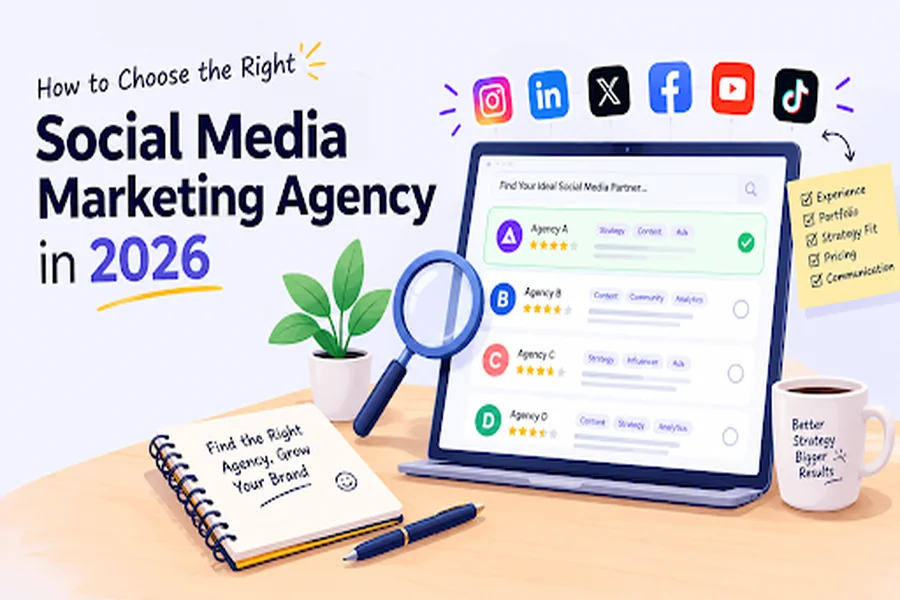

Picking a social media marketing agency feels a lot like hiring blind. Everyone’s portfolio looks polished. Everyone promises growth. And most pitches sound identical after the third call.
Here’s the thing: the agency that’s right for you depends less on their case studies and more on how they actually work. That’s the part most brands skip evaluating, and it’s the part that determines whether the partnership lasts six months or three years.
This guide breaks down what actually matters when you’re vetting one.
Start With What “Good” Looks Like for Your Brand
Before you even open a proposal, get specific about what success means. Is it leads? Brand awareness? Community growth? A social media agency built for e-commerce conversion looks nothing like one built for B2B thought leadership.
Honestly, most brands skip this step and end up comparing apples to oranges across five different pitches.
Quick summary: Define your primary goal, whether it’s leads, awareness, or retention, before evaluating agencies. The best social media marketing agency for a DTC brand rarely matches the best fit for a B2B company.
What Full-Service Support Actually Looks Like
A lot of agencies split strategy, creative, and reporting across different people who barely talk to each other. That gap shows up in inconsistent posting and messaging that drifts off-brand.
Teams offering full Social Media Services typically fold strategy, creative, and reporting into one connected process instead of treating each as a separate line item. That combination tends to produce steadier results than piecing vendors together, since nobody’s waiting on a handoff between departments.
Worth checking early: ask any agency you’re considering whether one team owns your account start to finish, or whether it gets split across departments.
Questions to Ask Before Signing Anything
Have you ever wondered why some agency relationships fall apart in month two? Usually, it’s because nobody asked the right questions upfront.
Ask these, at minimum:
- Who exactly works on my account day to day?
- How do you measure success beyond likes and followers?
- Can I see a full month of reporting from a current client?
- What happens if the assigned strategist leaves?
- How do you handle underperforming content?
A best social media marketing agency won’t dodge these. They’ll have answers ready, because they’ve been asked before.
Red Flags That Should Make You Pause
Some warning signs show up early, if you’re paying attention.
- Vague reporting that leans on vanity metrics
- Reluctance to share references or current client examples
- Contracts that lock you in for a year with no exit clause
- A pitch team that disappears after signing
- Cookie-cutter strategy decks that could apply to any industry
Important: If an agency can’t explain how their work ties back to revenue or pipeline, that’s worth a hard second look. Vanity metrics look good in a slide deck, but they rarely translate into business results.
What a Strong Social Media Agency Actually Delivers
Beyond the pitch, here’s what separates a genuinely good partner from one that’s just decent at posting content.
Platform-specific strategy, not copy-paste content
A single post reformatted five ways for five platforms isn’t a strategy. Each platform has different intent, different audiences, and different content formats that actually perform.
Real creative testing
Good agencies test hooks, formats, and posting times, then adjust based on what the data shows. They don’t set a calendar in January and run it unchanged through December.
Transparent, plain-language reporting
You shouldn’t need a data analyst to understand your monthly report. Clear numbers, clear takeaways, clear next steps.
A team that treats your brand voice as sacred
Your audience should recognize your brand’s tone in every post, comment reply, and caption, not spot the difference between agency weeks and in-house weeks.
Crisis-ready response plans
Things go sideways online fast. A strong agency has a plan for handling a negative comment wave or a PR misstep before it happens, not a scramble session after.
Clear ownership of paid and organic overlap
If they run paid social too, ask how organic and paid strategies inform each other. The best setups treat them as one connected system, not two teams working in silos.
Budget: What You’re Actually Paying For
Pricing varies wildly, and low cost usually means less strategic thinking, not just fewer posts.
A cheap retainer often means:
- Junior staff handling your account
- Templated content with minimal customization
- Limited testing or optimization
A fair retainer typically covers strategy time, creative production, community management, and reporting, not just scheduling.
Must Read: Compare quotes on scope, not just price. Two agencies quoting the same number might be offering completely different levels of service underneath.
Making the Final Call
Once you’ve narrowed your list, trust the details. How fast did they respond to questions? Did their proposal feel tailored, or recycled? Did the team on the call match the team promised in the contract?
Picture this: six months in, are you getting monthly calls that feel like a real strategic check-in, or a rushed update squeezed between other accounts?
That gut check matters as much as any case study.
FAQs
1. How much does a social media marketing agency typically cost?
Retainers usually range from a few thousand dollars monthly for small brands to five figures for larger, multi-platform programs. Scope and platform count drive most of the variance.
2. How long before I see results from a social media agency?
Expect early engagement shifts within 60-90 days. Meaningful growth in leads or revenue typically takes four to six months of consistent execution.
3. What’s the difference between a freelancer and an agency?
Agencies bring a full team, strategy, creative, and reporting, plus backup if someone leaves. Freelancers are often cheaper but carry more single-point-of-failure risk.
4. Should I choose the best social media marketing agency in my industry specifically?
Industry experience helps, but adaptable strategy and strong execution matter more. A great generalist agency often outperforms a mediocre niche specialist.
