
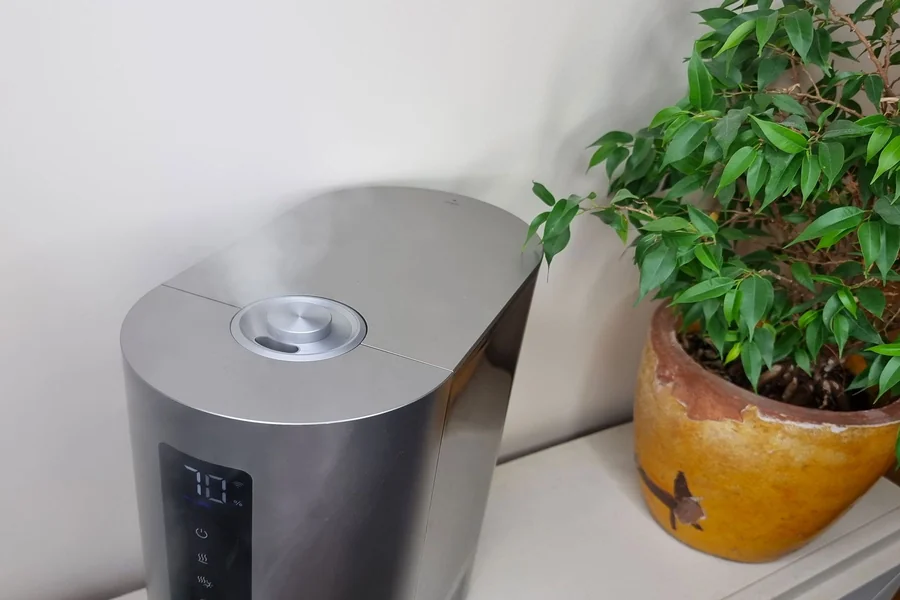
Winter changes more than the temperature outside.
Once central heating, radiators, fireplaces, and other heating systems start running regularly, indoor air can begin to feel noticeably drier. Bedrooms, home offices, and living spaces that felt comfortable during warmer months may suddenly benefit from additional humidity.
A humidifier offers a straightforward way to add moisture back into the air, but choosing one isn’t simply a matter of finding the model with the biggest water tank.
Different homes need different solutions.
A large open-plan living area may benefit from a high-capacity evaporative unit, while a bedroom may need something quieter and more compact. Some people want automatic humidity control, while others prioritize easy cleaning, simple controls, or the ability to manage the humidifier from an app.
With those differences in mind, we’ve selected five humidifiers that offer useful approaches to dry indoor air during the winter months.
1. Stadler Form Oskar
Best for: Efficient evaporative humidification
The Stadler Form Oskar takes first place because it combines straightforward evaporative humidification with automatic humidity control and a design that works well in different areas of the home.
Oskar is designed for rooms up to approximately 50 square meters, giving it enough capacity for many bedrooms, living rooms, and home offices.
Its 3.5-liter water tank feeds an evaporative system rather than producing a visible plume of mist.
One of its most useful features is the built-in hygrostat.
Instead of simply operating continuously until the tank is empty, Oskar allows users to select a desired humidity level. The unit can then regulate operation accordingly.
There are two output levels, with humidification capacity rated at up to 370 grams per hour.
Noise is also reasonably controlled, with Stadler Form listing an operating range of approximately 26 to 39 dB(A).
For nighttime use, the LEDs can be dimmed or switched off entirely.
Oskar also shuts itself down automatically when the water tank becomes empty and includes a reminder for changing its humidifier filters.
Key Features
- 3.5-liter water tank
- Evaporative humidification
- Designed for rooms up to 50 m²
- Up to 370 g/h humidification output
- Built-in hygrostat
- Two output levels
- 26–39 dB(A) operating range
- Dimmable or switchable LEDs
- Automatic shutoff when empty
- Filter-change reminder
- Can be refilled during operation
Best For
Oskar makes sense for someone who wants an evaporative humidifier that can automatically respond to the room rather than requiring constant adjustment.
It’s particularly well suited to people who prefer a traditional humidification system over a smart, app-connected appliance.
Potential Drawback
Oskar uses replaceable humidifier filters, so there is some ongoing maintenance and replacement cost to consider.
Users who prefer a filter-free system may want to consider an ultrasonic alternative.
2. AIRCARE MA1201 Console
Best for: Large rooms and whole-home coverage
Not everyone is trying to humidify a single bedroom.
For larger homes and open living spaces, a small bedside humidifier may simply lack the output and capacity required.
That’s where the AIRCARE MA1201 becomes interesting.
This is a considerably larger evaporative humidifier designed for coverage of up to 3,600 square feet.
Its 3.6-gallon capacity also means the water reservoir is in a completely different category from the smaller units on this list.
AIRCARE lists a maximum runtime of up to 36 hours.
The MA1201 includes an adjustable humidistat, allowing users to select a preferred humidity level rather than manually controlling output throughout the day.
An automatic setting can adjust fan speed to maintain that selection.
Four fan speeds provide additional control.
The unit also includes practical features such as automatic shutoff when empty, a refill indicator, a wick-change indicator, and casters that make it easier to reposition despite its larger dimensions.
Key Features
- 3.6-gallon capacity
- Coverage up to 3,600 square feet
- Up to 36 hours maximum runtime
- Evaporative system
- Adjustable humidistat
- Automatic fan adjustment
- Four fan speeds
- Automatic shutoff
- Refill indicator
- Wick-change indicator
- Digital controls
- Casters for easier movement
Best For
AIRCARE is the strongest option here for someone trying to address dry winter air across a much larger area.
It can make more sense than purchasing several small humidifiers for different parts of an open-plan home.
Potential Drawback
Size is the obvious compromise.
The MA1201 isn’t something you’d casually place on a nightstand or small dresser.
It’s better viewed as a larger household appliance than a discreet bedroom accessory.
It also uses a replaceable wick, adding another maintenance requirement.
3. Molekule Glow Humidifier
Best for: Smart control and everyday winter use
Molekule Glow occupies the middle of our list because it takes a very different approach from the large evaporative units above it.
Glow is a compact smart humidifier designed around convenience.
Its 2.8-liter tank provides up to 24 hours of humidification depending on mist intensity, making it practical for overnight use as well as everyday operation in bedrooms and other personal living spaces.
The biggest advantage is how much control it gives the user.
Glow offers low, medium, and high mist settings along with both manual and automatic operating modes.
In Auto Mode, the device can respond to the humidity in the room, switching mist on and off as required to work toward the selected level.
That can be particularly useful during winter.
Indoor conditions don’t remain identical throughout the day. Heating systems cycle on and off, doors open, and temperatures change.
Rather than manually changing output every few hours, automatic control allows the humidifier to handle much of that adjustment itself.
Glow also connects to the Molekule app.
From the app, users can monitor humidity, check the water level, and manage settings without needing to walk over to the device.
There are 2-, 4-, and 8-hour sleep timers for users who don’t want continuous operation.
Noise is another advantage.
Molekule specifies operation below 35 dB even on the highest mist setting, making Glow suitable for bedrooms, nurseries, and home offices where excessive background noise could become distracting.
Then there’s the design.
Glow includes programmable lighting with nine color options, allowing it to double as a subtle ambient light rather than looking purely like a household appliance.
The top-fill tank also simplifies refilling.
There’s no need to remove a full reservoir, flip it upside down, and carry it back to the base. Water can be added from the top.
For cleaning, the removable water-contact components are dishwasher-safe.
Key Features
- 2.8-liter tank
- Up to 24 hours of operation depending on mist intensity
- Under 35 dB even at the highest setting
- Three mist speeds
- Manual Mode
- Auto Mode
- Target humidity settings
- Molekule app connectivity
- Remote humidity monitoring
- Water-level monitoring
- 2-, 4-, and 8-hour sleep timers
- Nine programmable light colors
- Top-fill tank
- Dishwasher-safe removable components
- Double-wall, leak-resistant tank
Best For
Molekule Glow is the most compelling choice on this list for someone who wants a modern smart humidifier for a bedroom, home office, nursery, or similar everyday space.
Its biggest advantage isn’t raw capacity.
It’s convenience.
Automatic operation, app controls, quiet performance, timers, and straightforward refilling make it easy to incorporate into a normal winter routine.
Potential Drawback
Glow isn’t designed to humidify thousands of square feet like a large console unit.
Someone trying to address an entire large home with a single device would be better served by a high-capacity solution such as AIRCARE.
For room-by-room use, however, Glow offers a much more compact and connected experience.
4. Crane Drop Ultrasonic Cool Mist Humidifier
Best for: Simple and affordable everyday humidification
Not every household needs automatic humidity management or smartphone controls.
Sometimes a straightforward humidifier is exactly what you’re looking for.
The Crane Drop has been a recognizable option in this category for years.
Its teardrop-shaped design houses an approximately one-gallon, or 3.78-liter, water tank.
Crane lists runtime of up to 24 hours per tank, giving it enough capacity to run through the night and well into the following day depending on output.
It uses ultrasonic cool-mist technology.
The humidifier is rated for spaces up to approximately 250 square feet, positioning it primarily as a bedroom, nursery, or small-room option rather than a whole-home solution.
Noise is rated below 37 dB from three feet away.
That’s an important specification for users planning to operate the humidifier overnight.
The basic nature of the controls is part of the appeal.
There’s no need to connect another appliance to Wi-Fi or configure an app before using it.
Fill the tank, select the desired output, and let it run.
Key Features
- Approximately one-gallon tank
- Up to 24 hours of runtime
- Ultrasonic cool mist
- Coverage up to approximately 250 square feet
- Noise level below 37 dB from three feet
- Compact design
- Straightforward operation
Best For
Crane is a practical option for someone who wants simple humidification in a smaller bedroom or personal space without paying for advanced smart functionality.
Potential Drawback
The simplicity works both ways.
Users looking for app controls, automatic humidity management, sophisticated scheduling, or remote water-level monitoring won’t find the same functionality offered by Molekule Glow.
5. Honeywell Cool Moisture Humidifier
Best for: Traditional evaporative humidification
Honeywell has long been associated with practical home comfort appliances, and its cool-moisture humidifiers represent a more conventional approach to managing dry indoor air.
Rather than emphasizing smartphone connectivity or decorative lighting, Honeywell’s evaporative designs focus on the fundamentals.
Water is absorbed through a wick before a fan helps distribute moisture into the surrounding air.
For users who specifically prefer evaporative humidification, this approach can be attractive because it doesn’t create the same visible mist associated with ultrasonic units.
Honeywell models in this category are particularly well suited to people who want a recognizable household brand and don’t consider connected features essential.
The tradeoff is maintenance.
As with other wick-based evaporative systems, filters eventually need attention and replacement.
Key Advantages
- Evaporative humidification
- Cool-moisture operation
- Straightforward controls
- No need for smartphone connectivity
- Established home-comfort brand
- Suitable for everyday winter use
Best For
Honeywell is worth considering if you want a conventional humidifier without paying extra for a long list of connected features.
Potential Drawback
The wick-based system means filters become part of the ownership routine.
Those who want fewer replaceable components may prefer an ultrasonic design.
Why Does Indoor Air Feel Drier During Winter?
Cold weather changes indoor conditions in several ways.
Outdoor winter air generally contains less moisture than warmer air.
Once that air enters the home and is heated, relative humidity can drop significantly.
Heating systems can make the difference particularly noticeable.
This is why the problem often becomes more apparent shortly after households begin using central heating regularly.
A hygrometer can be useful if you want to understand what’s actually happening rather than relying entirely on how the room feels.
It allows you to monitor relative humidity and make more informed decisions about when a humidifier needs to operate.
Bigger Isn’t Always Better
One of the easiest mistakes when shopping for a humidifier is assuming that the biggest tank automatically means the best product.
Tank capacity matters, but context matters more.
The AIRCARE MA1201 has an enormous advantage when you’re dealing with a large living space.
Place the same appliance next to a small bed, however, and its size becomes a disadvantage.
Molekule Glow goes in the opposite direction.
Its 2.8-liter tank isn’t intended to compete with a 3.6-gallon console humidifier. Instead, it’s designed around convenient room-level operation.
Start with the size of the space.
Then consider capacity.
Evaporative or Ultrasonic?
The five products on this list demonstrate two of the most common approaches to household humidification.
Evaporative Humidifiers
Evaporative systems typically use a wick or filter to absorb water.
A fan moves air across the wet material, allowing moisture to enter the room through evaporation.
Stadler Form Oskar and AIRCARE MA1201 use this general approach.
These systems don’t create the same visible plume of mist associated with ultrasonic humidifiers.
The main compromise is that wicks or filters generally become part of the maintenance routine.
Ultrasonic Humidifiers
Ultrasonic humidifiers use high-frequency vibrations to create a fine mist.
These systems can be very quiet and compact, which helps explain why they’re common in bedrooms and other personal spaces.
Molekule Glow and Crane Drop use ultrasonic humidification.
Which system is better depends on the room, maintenance preferences, water quality, and the features you value.
Automatic Humidity Control Is Worth Considering
Winter humidity isn’t static.
Conditions change as the heating system cycles, outside temperatures shift, people enter and leave rooms, and doors or windows are opened.
This is why automatic humidity control can be more useful than simply having several output speeds.
Stadler Form Oskar includes a built-in hygrostat.
AIRCARE offers an adjustable humidistat and automatic fan-speed control.
Molekule Glow provides Auto Mode and lets users select target humidity settings while also monitoring conditions through the app.
These features can reduce the amount of manual intervention required.
Think About Noise Before Buying
Humidifier noise may seem unimportant when you’re comparing products during the day.
At midnight, the situation can feel very different.
For bedrooms and nurseries, operating volume deserves attention.
Molekule Glow stays below 35 dB even on its highest setting.
Stadler Form lists Oskar at approximately 26 to 39 dB(A), depending on operation.
Crane lists its Drop model below 37 dB from three feet away.
For a living room or open-plan space, a little extra sound may not matter.
For a light sleeper, it could become one of the most important differences between models.
Maintenance Matters More Than You Think
Every humidifier needs maintenance.
Water sits inside the device, so regular cleaning should be treated as part of normal ownership rather than an occasional extra.
Different designs approach this in different ways.
Evaporative models typically introduce replaceable wicks or filters.
Ultrasonic models may eliminate that requirement but still need regular cleaning to deal with mineral buildup and keep water-contact areas clean.
Molekule recommends a quick rinse and wipe weekly and a deeper clean with water and vinegar at least monthly.
Its removable water-contact components are dishwasher-safe, which can make routine cleaning easier.
Whatever model you choose, follow the manufacturer’s specific instructions rather than assuming every humidifier can be cleaned the same way.
Top-Fill Designs Can Make Life Easier
Refilling sounds like a minor detail until you’ve done it dozens of times.
Older humidifier designs often require removing a tank, carrying it to the sink, turning it upside down, filling it, replacing a cap, flipping it again, and returning it to the base.
Top-fill systems simplify the process.
Molekule Glow can be filled from above, reducing the amount of handling involved.
Stadler Form Oskar can also be refilled through its filling opening, including while the unit is operating.
For a humidifier used every day throughout winter, small conveniences like these add up.
Where Should You Put a Humidifier?
Placement can influence how effectively a humidifier works.
Manufacturer instructions should always be your first reference because different designs require different amounts of clearance.
In general, avoid placing a humidifier where airflow is blocked.
Don’t position it directly against materials that could be affected by moisture.
For ultrasonic models, surrounding surfaces deserve particular attention.
Molekule recommends placing Glow on a nightstand or dresser with clearance from curtains, carpet, and upholstery.
A stable, appropriate surface is important regardless of which model you’re using.
Bedroom vs. Living Room Humidifiers
Bedroom priorities are usually different from living-room priorities.
In a bedroom, quiet operation, compact dimensions, timers, and dimmable controls can be particularly valuable.
This is where Glow performs strongly.
Its under-35 dB operation, sleep timers, app control, and programmable lighting are naturally suited to overnight use.
In a living room, raw output and coverage may become more important.
A larger evaporative system such as AIRCARE can therefore make considerably more sense.
Oskar sits somewhere between those extremes, combining relatively substantial room coverage with quiet operation and dimmable lighting.
Smart Controls Can Be Genuinely Useful
Not every household appliance needs an app.
A smart toaster probably isn’t going to transform most people’s mornings.
Humidifiers are different because several connected functions can solve genuine inconveniences.
Checking the water level remotely is useful.
Changing the target humidity without walking into another room is useful.
Setting timers is useful.
Seeing current humidity can also help users understand when the device actually needs to operate.
Molekule Glow integrates these functions through the Molekule app, which was updated in 2026 to support the humidifier.
For users who enjoy smart-home convenience, this makes Glow one of the more interesting options in the category.
Consider Your Winter Routine
Before buying a humidifier, think about when you’ll actually use it.
Will it run every night beside the bed?
Do you need something for an office during working hours?
Are you trying to manage a large living room?
Or do you want one unit capable of covering a substantial portion of the house?
These questions quickly narrow down the options.
A large console unit is unnecessary if you only want bedroom humidification.
A small bedside model may be frustrating if you’re trying to address a large open-plan living space.
Buying for the actual room is more useful than buying based solely on the longest feature list.
Which Humidifier Is Right for You?
Choose Stadler Form Oskar if you want quiet evaporative humidification, automatic humidity control, and enough capacity for a medium-sized room.
Choose AIRCARE MA1201 if coverage is your priority and you need a larger system for an open-plan area or substantial portion of the home.
Choose Molekule Glow if you want a compact smart humidifier with app controls, automatic operation, quiet performance, sleep timers, and easy top filling.
Choose Crane Drop if you want a straightforward ultrasonic humidifier for a smaller room without paying for extensive smart functionality.
Choose Honeywell if you prefer a conventional evaporative system from an established home-comfort brand and don’t mind maintaining a wick or filter.
Final Verdict
Winter can make indoor comfort surprisingly dependent on what’s happening in the air, not just the temperature displayed on the thermostat.
The right humidifier should match both the room and the way you live.
Stadler Form Oskar takes our top position for its combination of evaporative operation, built-in humidity control, quiet performance, and useful room coverage.
AIRCARE MA1201 comes second because its large capacity and coverage make it a much stronger choice for substantial spaces.
In third place, Molekule Glow offers perhaps the most modern experience of the group. Its 2.8-liter tank, up-to-24-hour runtime, sub-35 dB operation, Auto Mode, app connectivity, sleep timers, top-fill design, and ambient lighting make it particularly attractive for bedrooms and everyday room-by-room use.
Crane provides a simpler ultrasonic alternative, while Honeywell remains a practical option for shoppers who prefer traditional evaporative humidification.
Ultimately, don’t choose a humidifier based on capacity alone.
Consider where you’ll use it, how often you want to refill it, how much maintenance you’re willing to do, whether noise matters, and whether automatic or app-based controls would actually improve your routine.
The best winter humidifier is the one that fits into your home easily enough that you’ll continue using it throughout the dry season.
