
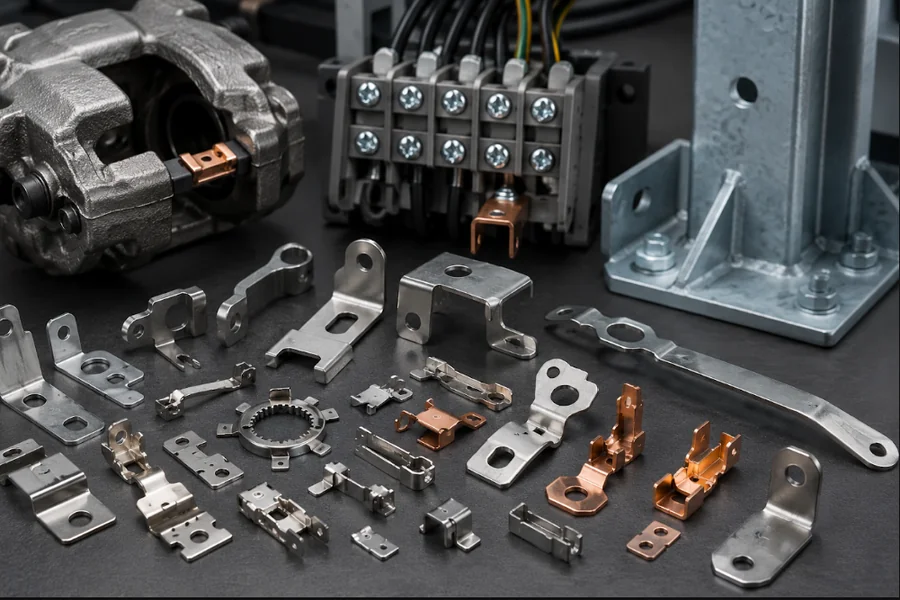

HAGENS (Hagens A/S) is a global supplier of precision metal components, including steel stamped parts manufactured to customer specifications for industrial and technical applications. Their components turn up in places most people never see – behind a brake caliper, inside an electrical enclosure, buried in a structural fitting. This article covers how stamped parts function in real industrial contexts, why tight-tolerance manufacturing matters, and where these parts end up in finished technical constructions.
What Industrial Stamped Parts Actually Do
Most stamped parts do their job out of sight. They sit inside a machine or an assembly, holding a connection, guiding a movement, or triggering a signal. The end user never notices them until something stops working.
Steel holds its shape under load, resists deformation over years of service, and can be formed into precise geometries at volume. In technical constructions and long-term installations, that combination of strength and adaptability is hard to replace.
The defining requirement is dimensional accuracy. A part that fits perfectly in one batch and loosely in the next is useless on an assembly line. HAGENS produces stamped parts to tight tolerances across documented applications in automotive, electrical, and building sectors, which is why the same component performs identically whether it leaves the press today or next quarter.
Three Sectors Where Stamped Parts Are Indispensable
In the three sectors below, alternative manufacturing methods simply do not deliver the accuracy or repeatability the application demands.
- Automotive. Safety-critical components live here. A brake wear indicator contacts the disc once the pad wears down, producing the warning sound a driver hears. Get the geometry wrong and the warning comes too early or too late – neither is acceptable in a braking system.
- Electrical assemblies. Screw terminals depend on precise stamped contacts to hold a wire securely and conduct current without resistance or heat build-up. The clamping geometry has to be exact, batch after batch, because a loose connection in a control panel is a fault waiting to happen.
- Building industry components. Structural fittings, brackets, and fastening elements carry load in installations meant to last for decades, through years of thermal cycling and stress. Off-the-shelf approximations do not survive that kind of duty.
In each case, the tolerance is not a preference. It is a functional requirement written into how the finished construction behaves.
Why Tight Tolerances Define the Product Category
A tolerance is the allowable deviation from a target dimension. For a stamped part in a safety-critical or long-term installation, that window can be the difference between a component that seats correctly and one that fails under load.
When parts are made to international standards, every unit across every batch falls inside the same specification. An engineer designing an assembly can trust that the component behaves the same whether it comes from the first production run or the fifty-thousandth. Without that guarantee, you cannot build a reliable machine on top of it.
Common Errors When Specifying Stamped Components
Most problems with stamped parts start on the specification sheet, not at the press.
- Underspecifying tolerances. Leaving the tolerance band too wide to save cost, then discovering that “close enough” parts do not fit the final assembly.
- Choosing the wrong material grade. Picking a steel that suits a bench test but corrodes or fatigues in the real installation environment, whether that means humidity, heat, or constant vibration.
- Ignoring assembly fit. Specifying a part in isolation without checking how it seats against the components around it in the finished construction.
- Skipping volume planning. Ordering a prototype run to one standard, then finding the production quantity behaves differently because the process was never validated at scale.
- Treating the drawing as final. Handing over a geometry without discussing whether it can actually be stamped efficiently, which drives up cost and lead time.
Talking through material, tolerance, and application context with the manufacturer before production catches nearly all of them.
Custom Manufacturing to Specification
Industrial stamped parts are rarely pulled off a shelf. They are built to a customer’s drawing, because the geometry, tolerance band, material, and volume are specific to the assembly they belong to. The process starts with a conversation about what the part has to do, then moves through tooling and validation before full production.
HAGENS operates at this scale globally, producing not only stamped parts but also springs, clips, and other custom precision metal components to customer specification. You can see the broader range at hagens.com.
Getting the Specification Right
In technical constructions where no room for error exists, the quality of individual stamped components determines the reliability of the whole assembly. Getting the specification right from the start, covering material, tolerance, and application context is what separates a component that lasts from one that fails.
