
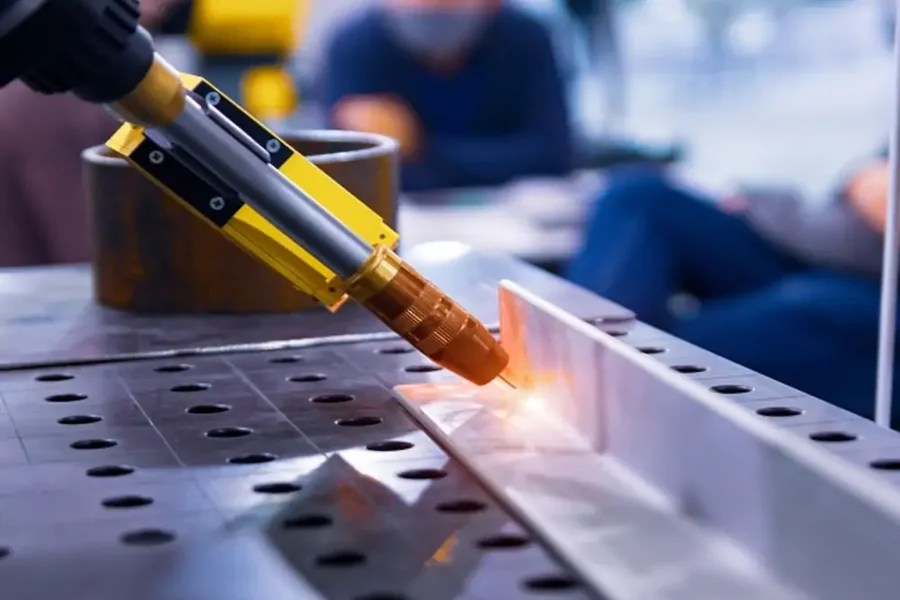

Everyday workshop operations demand tools that deliver speed, accuracy, and reliability. Yet many teams still struggle with problems like heat distortion, slow production speeds, and rework caused by inconsistent weld quality.
This is where the modern industrial laser welder has become an essential upgrade for workshops across industries. From automotive repair shops to electronics manufacturing facilities, laser welding systems are now woven into daily workflows because of their precision, adaptability, and automation-friendly design. As manufacturers continue to seek efficient and high-quality production methods, laser welding technology offers a solution that improves output while reducing waste and labor effort.
How Laser Welding Works in Workshop Settings
Process Overview
Laser welding relies on concentrated laser beams to melt and fuse materials—most commonly metals and certain thermoplastics. Workshops typically use two primary methods:
- Keyhole welding: Generates deep, narrow welds ideal for thick metals, structural components, and high-strength joints.
- Conduction welding: Produces shallow, broad welds suitable for thin materials, delicate parts, and aesthetically sensitive applications.
The laser’s precision ensures consistent weld penetration while minimizing thermal impact on surrounding areas.
Laser Types in Use
Workshops use different laser types depending on materials and application needs:
- Fiber lasers: Fast, energy-efficient, and ideal for metal welding. Excellent for stainless steel, aluminum, and galvanized metals.
- CO₂ lasers: Useful for plastics, thick plates, and specific non-metal materials.
- Nd:YAG lasers: Known for strong, focused power—ideal for jewelry repair and mold restoration.
Common Daily Workshop Applications
Automotive Assembly and Repair
Automotive facilities use industrial laser welders every day for tasks such as:
- Joining car body panels with minimal heat distortion
- Welding battery packs in EV systems
- Repairing exhaust systems
- Restoring engine components and frame structures
Laser welding ensures strong, clean welds that maintain the structural integrity of vehicles.
Metal Fabrication and Tooling
Fabrication shops rely on laser welders to produce and repair precision tools and molds. Workshop teams benefit from the ability to:
- Weld hardened steels and alloy tool materials
- Restore damaged mold edges
- Conduct micro-welding on fine components
This preserves metallurgical properties that traditional methods often compromise.
Jewelry and Artistic Work
Laser welding enables delicate work on luxury metals such as:
- Gold
- Silver
- Platinum
Because it generates minimal heat, jewelers can repair fragile parts without damaging surrounding stones or metalwork.
Electronics and Consumer Goods Manufacturing
Laser welders support daily output in electronics workshops by enabling:
- Micro-welding on circuit boards
- Sensor assembly
- Battery tab welding
- Joining copper and aluminum micro-components
The precision ensures surrounding parts remain unharmed, reducing failures and rework.
Medical Device Manufacturing
Laser welders are crucial in producing:
- Stainless steel surgical instruments
- Titanium implants
- Specialty medical housings
These welds must be biocompatible and free from contamination—requirements laser welding meets consistently.
Aerospace and Aviation Maintenance
Workshops in aerospace use industrial laser welders to repair:
- Titanium turbine components
- Aluminum structural parts
- Frame sections
The deep penetration and low heat distortion help maintain the strict tolerances required in aviation.
Rail, Shipbuilding, and Structural Fabrication
Large-scale workshop environments use laser welders to join:
- Railway steel components
- Ship hull sections
- Heavy structural assemblies
Welds are durable, clean, and strong enough to withstand high-stress environments.
Productivity Enhancements in Workshops
High-Speed Processing
An industrial laser welder is significantly faster than traditional welding methods—meaning you can complete more work in less time. This helps workshops meet deadlines for:
- Mass production
- Rapid prototyping
- High-volume repairs
Accuracy and Consistency
Laser welding reduces manual errors and ensures uniform weld quality, making it ideal for:
- Automated production lines
- Precision repair tasks
- High-repeatability parts
Consistency is especially valuable for quality-critical industries like automotive, aerospace, and medical devices.
Minimal Post-Processing
Because laser welds produce smooth, clean seams:
- Little to no grinding is required
- Finishing costs decrease
- Workshop teams save labor hours
This is especially beneficial for workshops handling decorative metalwork or fine components.
Energy and Cost Efficiency
Laser welding improves operational efficiency by:
- Using less power
- Requiring fewer consumables
- Reducing scrap rate
- Minimizing rework
Long-term, this significantly lowers overall production costs.
Integration and Versatility
Compatibility with Automation
Laser systems integrate easily into existing workshop workflows, including:
- Robotic arms
- CNC stations
- Automated conveyor lines
This boosts output while reducing manual workload.
Multi-Material Capability
Industrial laser welders can join similar or dissimilar metals under controlled parameters, including:
- Aluminum + steel
- Stainless steel + copper
- Titanium + alloys
This is especially useful in hybrid manufacturing or electronics assembly.
Compact Equipment Options
Modern laser welders come in compact configurations, allowing smaller workshops to adopt advanced technology without sacrificing valuable floor space. Machines from Denaliweld are engineered to provide powerful results in streamlined, workshop-friendly designs—giving you flexibility no matter your workspace size.
Safety and Maintenance in Daily Use
Safe Operation Standards
Workshop teams must follow established safety procedures, including:
- Wearing certified protective laser eyewear
- Maintaining shielding around the welding area
- Ensuring operators receive proper training
Many laser welding machines include built-in safeguards such as interlocks, enclosures, and controlled laser zones.
Low Maintenance Needs
Fiber laser systems require minimal servicing thanks to:
- Few moving parts
- Efficient air or water-cooling units
- Long operational lifespans
This reduces downtime, lowers maintenance costs, and ensures smoother daily workflows.
Conclusion
A modern industrial laser welder brings versatility, speed, and precision to everyday workshop operations. Whether you’re restoring automotive components, crafting jewelry, assembling electronics, or working on structural projects, laser welding offers strong, clean, and consistent results with minimal rework.
As workshops continue to adopt smarter, more efficient technologies, laser welding systems are becoming indispensable tools for improving quality and productivity. If you’re ready to enhance your workshop’s capabilities, explore reliable, high-performing equipment and discover solutions designed for real-world daily use.
