
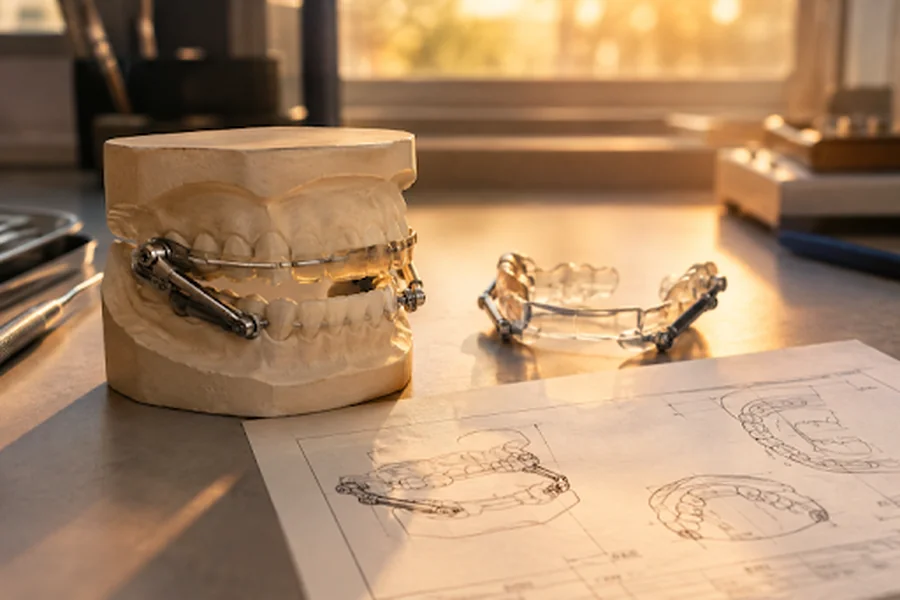

For orthodontists, a successful Herbst delivery starts well before the insertion appointment. OrthoDenco Orthodontic Lab approaches every Herbst orthodontic appliance case as a prescription-driven fabrication project, with attention to the framework, anchorage design, band adaptation, telescoping mechanism, and requested accessories.
Herbst therapy can be an effective option for selected Class II patients. Still, the appliance must be appropriate for the clinician’s treatment plan and fabricated to function within the patient’s occlusion. OrthoDenco Orthodontic Lab helps practices submit clearer case instructions and receive custom appliances tailored to their design preferences.
Why OrthoDenco Orthodontic Lab Is a Practical Herbst Partner
OrthoDenco Orthodontic Lab provides a focused workflow for orthodontic practices that need customized functional appliances. The lab accepts digital STL files and supports conventional records, allowing offices to choose the submission method that fits their clinical process. Its published capabilities include custom appliance fabrication, a stock of molar bands and archwire tubes, and direct scan-and-prescription workflows with supported scanning systems.
Practices can review the lab’s broader appliance capabilities through orthodenco.com, then use a detailed Herbst prescription to communicate the design, mechanism, anchorage, bite position, and special requirements for the individual case.
Case Selection Starts With the Orthodontist’s Treatment Objectives
OrthoDenco Orthodontic Lab is most effective when the treating orthodontist provides a complete clinical direction. The clinician remains responsible for patient selection and treatment decisions, while the laboratory translates the prescription into an appliance design. That distinction matters because a Herbst appliance is not a one-design answer for every Class II presentation.
Before fabrication, the prescription should specify the intended framework, attachment teeth, preferred mechanism, requested advancement, vertical considerations, and any expansion or archwire components. A meta-analysis found that Herbst treatment can produce active-treatment changes in Class II patients, while also noting that more evidence is needed to establish long-term effects. That makes careful case planning and clear appliance instructions especially important for each patient.
Information That Helps OrthoDenco Orthodontic Lab Fabricate With Fewer Unknowns
- Complete patient and prescribing-doctor information.
- A digital scan, impression, or accurate model with all required teeth captured.
- The desired Herbst framework and telescoping mechanism.
- Band, crown, splint, rest, tube, lingual arch, or transpalatal arch requirements.
- Expansion instructions when transverse development is part of the plan.
- Bite registration, mandibular advancement, and occlusal instructions.
- Photographs, diagrams, or written notes that clarify nonstandard design requests.
Band Fit Is the Foundation of Herbst Stability
Band adaptation is one of the most important markers of a well-fabricated Herbst appliance. A band or crown that does not seat fully and consistently can complicate cementation, cause rocking, alter force distribution, and lead to additional chair time for troubleshooting. OrthoDenco Orthodontic Lab’s custom band-fitting capability gives orthodontists a practical way to specify the appliance’s anchorage foundation rather than relying on a generic approach.
For the best result, the submitted records should clearly identify the intended teeth and show enough anatomy for the prescribed bands or crowns to be evaluated on the model. OrthoDenco Orthodontic Lab can also incorporate the requested tubes and wire accessories into the design, ensuring the appliance arrives as a coordinated unit rather than a collection of unrelated components.
Telescoping Arm Alignment Separates Functional Design From Mere Assembly
A Herbst mechanism must do more than appear correctly attached. The upper and lower telescoping arms need a relationship that supports opening, closing, protrusive function, and lateral movement without obvious interference. OrthoDenco Orthodontic Lab considers the anchorage units, framework position, prescribed advancement, and arm placement when fabricating a custom Herbst design.
Poor alignment can contribute to binding, excessive stress at connectors, unwanted cheek contact, or difficulty with normal mandibular movement. The treating orthodontist can help OrthoDenco Orthodontic Lab avoid these variables by submitting an accurate bite record and noting any specific vertical, movement, or comfort concerns. Smooth mechanism function begins with precise records and a fabrication plan that respects the patient’s actual occlusion.
Where Herbst Appliances Commonly Need Durable Fabrication
Herbst appliances operate in a demanding environment. Areas that deserve close attention include the band-or-crown interface, acrylic transitions, soldered or welded connections, screws, connectors, and the telescoping tube-and-rod assembly. Research on Herbst complications has reported issues such as splint loosening, telescope breakage, splint breakage, and reduced comfort, underscoring the importance of appliance design and fabrication details.
OrthoDenco Orthodontic Lab addresses preventable fabrication risks through prescription review, case-specific component selection, custom fabrication, and pre-delivery inspection. This does not mean any Herbst unit is immune to repair. Chewing forces, parafunction, oral hygiene, cementation, eruption, patient growth, and treatment mechanics can all affect appliance performance after insertion.
Custom Components Help OrthoDenco Orthodontic Lab Match the Prescription
OrthoDenco Orthodontic Lab can support Herbst cases requiring acrylic or cantilever-style frameworks, telescoping mechanisms, molar bands, crowns, expansion options, and integrated wire accessories. The advantage for the orthodontist is the ability to request a coordinated design that reflects the planned mechanics rather than adapting a one-size-fits-all appliance at delivery.
When expansion is part of treatment, the prescription should state the requested expander configuration and any related appliance features. When lingual arches, transpalatal arches, rests, or archwire tubes are needed, OrthoDenco Orthodontic Lab can incorporate those details into the fabrication plan. Complete instructions reduce ambiguity and support a more efficient office-to-laboratory workflow.
Digital Submission Supports Clearer Communication
Digital workflows can make it easier for practices to send records and prescriptions together. OrthoDenco Orthodontic Lab accepts STL files and can receive scans and prescriptions through supported digital systems, while also accommodating offices that prefer physical impressions or models. Regardless of the format, the clinical record must accurately capture the required dentition and bite relationship.
Before submitting a digital Herbst case, practices should verify the scan’s completeness, attach the correct prescription, identify the framework and mechanism, list all accessories, and include special instructions in a single location. That preparation allows OrthoDenco Orthodontic Lab to focus on fabrication rather than on resolving avoidable omissions.
Quality Checks Before the Insertion Appointment
Orthodontists and team members should confirm that the delivered appliance matches the order before the patient arrives. Review whether the bands or crowns are seated on the submitted model, the requested accessories are present, the acrylic is finished smoothly, and the telescoping arms appear properly positioned. OrthoDenco Orthodontic Lab’s value is not a promise that every patient will need no adjustment. Its value is a fabrication process centered on accuracy, customization, and communication before the appliance reaches the operatory.
