
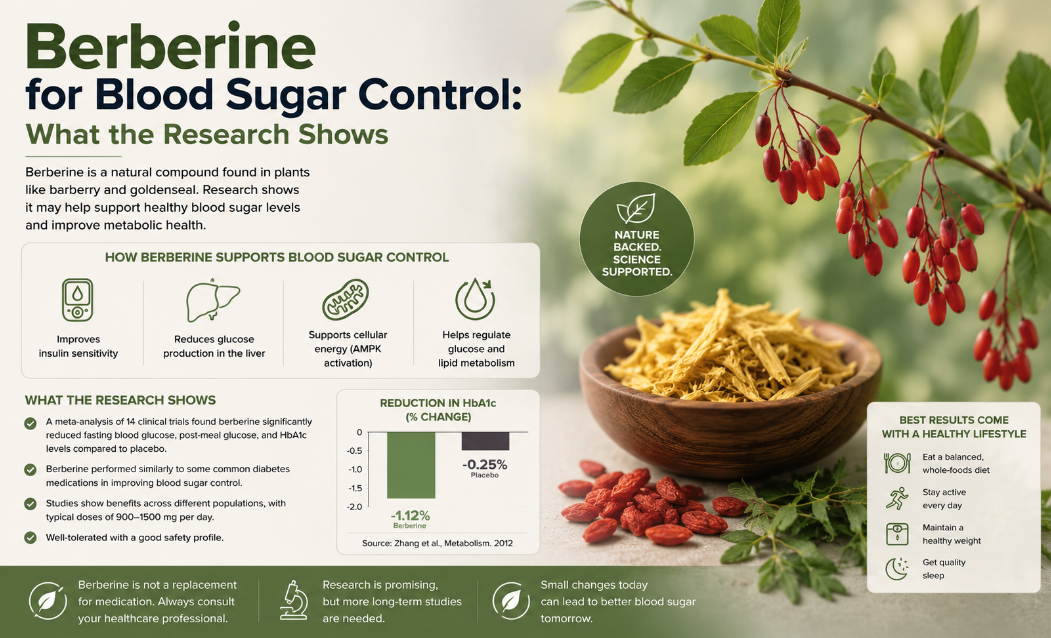

Berberine for Blood Sugar Control: What the Research Shows
If someone had told you ten years ago that a plant alkaloid could lower blood sugar almost as well as a prescription drug, it would have sounded like marketing spin. Today it’s not spin. It’s the subject of dozens of clinical trials, and the results for berberine are genuinely impressive. If you’ve been browsing an organic supplement store Herbal Lab and noticed berberine on the shelf next to more familiar names, there’s a good reason it’s there.
What berberine actually is
Berberine is found in barberry, Oregon grape, tree turmeric, and goldenseal. Traditional Chinese medicine has used it for centuries to treat digestive problems and infections. Modern interest picked up after researchers noticed something odd: patients taking it for diarrhea also saw their blood sugar drop. That observation kicked off a wave of research that’s still going more than twenty years later.
How berberine affects glucose levels
The mechanism is well understood at the cellular level. Berberine activates an enzyme called AMP-activated protein kinase, or AMPK, often described as the body’s metabolic switch. Turning on AMPK pushes muscle and liver cells to pull more glucose out of the bloodstream, reduces glucose production in the liver, and improves how sensitive tissues are to insulin. In effect, berberine triggers many of the same processes that happen during exercise, just through a molecule instead of a workout.
It also slows carbohydrate absorption in the gut and shifts gut bacteria toward strains linked to better metabolic health. That combination of mechanisms is probably why the effect has held up so consistently across studies.
Numbers worth paying attention to
In 2008, the journal Metabolism published a study comparing 500 mg of berberine three times a day for three months against metformin in patients with type 2 diabetes. The drop in HbA1c was comparable to metformin, and fasting glucose fell by roughly 20 percent.
A later meta-analysis pooling 27 randomized trials with more than 2,500 patients found that berberine lowered fasting glucose by an average of 1.5 mmol/L and HbA1c by 0.9 percentage points. It also improved the lipid profile across the board: total cholesterol, LDL, and triglycerides went down while HDL went up. Getting that kind of broad effect across several metabolic markers at once is unusual, even among pharmaceutical drugs.
Some studies combined berberine with statins or lifestyle changes. The effect in those cases was stronger than either intervention alone. Berberine seems to work best not as a replacement for standard treatment, but as something added on top of it.
Honestly, seeing a plant extract with this many randomized trials behind it is rare on its own. Most supplements are riding on one or two small studies and a lot of marketing. Berberine has built up more than twenty years of data that holds up about as well as many prescription drugs, and in terms of how many metabolic markers it touches, it arguably does more.
Who benefits most
Berberine is best studied in people with prediabetes, insulin resistance, metabolic syndrome, and mild to moderate type 2 diabetes. It’s also shown good results for women with polycystic ovary syndrome, where insulin resistance is often at the root of the problem. Several studies found that berberine improved both glucose markers and hormonal profiles in this group, which matters because the two are usually tied together.
How to take berberine for the best results
One practical problem with berberine is that it’s poorly absorbed in its raw form. Bioavailability in the gut is fairly low, which has a couple of real implications for how you take it.
A liquid berberine tincture tends to absorb faster than capsules, since the active compound is already dissolved and doesn’t need to break down a capsule shell first. Most studies used 900 to 1,500 mg a day, split into two or three doses with meals. That timing is a nice coincidence: the stomach tolerates berberine better with food, and mealtime is exactly when the body needs help handling incoming glucose anyway.
Pairing it with alpha lipoic acid, which also affects insulin sensitivity and brings its own antioxidant properties, produced a stronger effect than berberine alone in a few smaller studies. That’s part of why combination formulas are becoming more popular among people taking a more systematic approach to metabolic health.
What to keep in mind
Berberine is usually well tolerated, though some people notice mild stomach discomfort in the first few days that tends to settle on its own. Since it affects blood sugar, anyone already on glucose-lowering medication should check with a doctor before adding it, to avoid glucose dropping too far too fast. It’s generally not recommended during pregnancy or breastfeeding, since safety data for those groups is limited.
Is it worth trying
Berberine is one of the few plant extracts where the science doesn’t just hint at a benefit. It shows a specific, measurable, repeatable effect on blood sugar that holds up against classic pharmaceutical drugs. For people with prediabetes, insulin resistance, or mild type 2 diabetes, it’s a real tool for improving your numbers, especially paired with diet and exercise. Given how much evidence has piled up, berberine earns its place among the most scientifically defensible plant supplements for metabolic health.
