
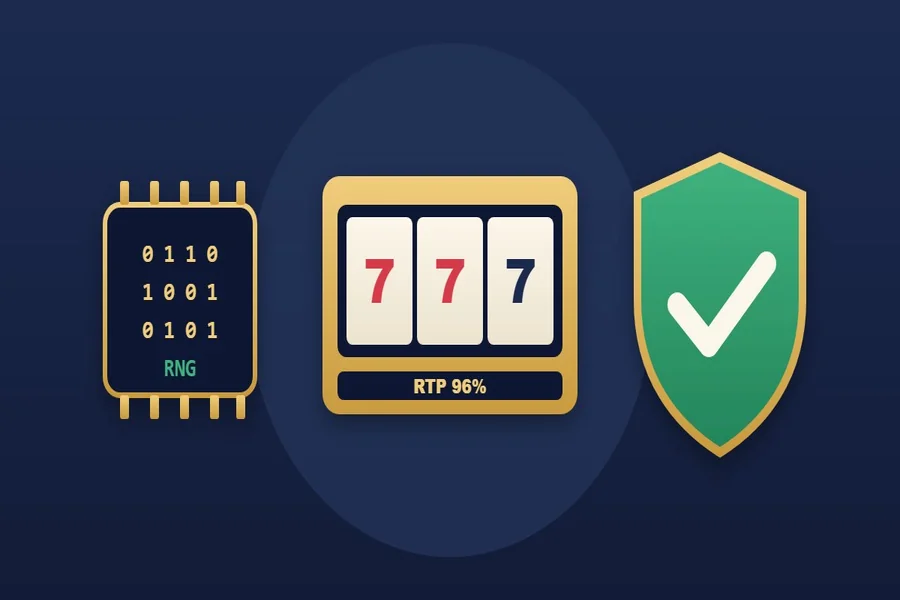

Tap a button on your phone, and within a second five reels spin, stop and either light up or fall silent. To the player, an online slot feels like a game of chance wrapped in colorful graphics. Behind the screen, it is something closer to a piece of financial software: a random number generator, a carefully designed payout model and layers of independent testing. Understanding how that technology works will not change your luck, but it will change how you see the game, and how you judge whether a casino deserves your trust.
The random number generator: the engine behind every spin
At the heart of every online slot is a random number generator, or RNG. It is an algorithm that produces a constant stream of numbers, cycling through thousands or even millions of values per second whether anyone is playing or not. The moment you press spin, the game takes the current number and maps it to a result on the reels.
The key point is that each spin is independent. The RNG has no memory of previous results, so a machine is never “due” a win after a long losing streak, and a big payout does not make the next spin any less likely to win. The animation of spinning reels is purely visual. The outcome has already been decided by the number the RNG produced at the instant you pressed the button.
RTP: the long-term payout figure
Every slot is designed with a theoretical return to player, or RTP. It describes the share of all money wagered on a game that is expected to be paid back to players over a very large number of spins. A slot with an RTP of 96 percent is designed to return, on average, £96 for every £100 wagered across millions of spins, with the remaining £4 representing the house edge.
The word that matters is long-term. RTP says nothing about what will happen in a single session. One player may win far more than they stake in an evening, while another loses their entire budget, and both outcomes are consistent with a 96 percent RTP. The figure is best understood like the expense ratio on a fund: it describes the built-in cost over time, not the result of any individual day.
Volatility: why two slots with the same RTP feel completely different
Two games can have exactly the same RTP and still feel nothing alike. The difference is volatility, sometimes called variance. A low-volatility slot pays out small wins frequently, keeping a balance relatively stable. A high-volatility slot pays out less often, but when it does, the wins can be much larger, which means longer losing runs and bigger swings in between.
For players, volatility is arguably more important to the experience than RTP. Someone with a small budget who wants a long session is usually better suited to low-volatility games, while high-volatility games appeal to those chasing large but rare wins. Many game providers publish volatility ratings alongside RTP, and reading both together gives a much clearer picture of what to expect than either number on its own.
How games are tested and certified
Because players cannot see inside the software, regulated markets rely on independent testing. In Denmark, the Danish Gambling Authority requires games, gaming platforms and random number generators to be tested by an accredited testing company under its certification programme before they can be offered to players. The aim is to ensure that games execute correctly, that results are genuinely random and that the systems around them are secure.
Certification is not a one-off formality. Licence holders and game suppliers must remain certified for the products they offer, and changes to components that affect the RNG or game rules trigger new testing. That is a key difference between licensed and unlicensed casinos. On a site without a recognized licence, there is no independent guarantee that the published RTP is accurate, or that the game behaves the way it claims to. Guides that cover the Danish market, CashCasino.dk among them, therefore treat the licence as the first thing to check.
Common myths the technology disproves
Slot machines have attracted myths for as long as they have existed, and many have carried over to online games. The most common is the idea of hot and cold machines: that a game which has not paid out for a while is about to, or that one which just paid out will now go quiet. Because each spin is independent, neither is true. Another myth is that the time of day, or playing on a weekend, affects payouts. The RNG does not know what time it is.
Then there is the near miss, where two jackpot symbols land and the third stops just above or below the line. It feels like you nearly won, but in an RNG-driven game, a near miss is simply one of many possible outcomes and says nothing about the next spin. Knowing this helps players resist one of the most powerful psychological pulls in gambling: the feeling that a win is just around the corner.
What it means when you choose where to play
For players, the practical lesson is that the technology is only as trustworthy as the oversight behind it. A licensed casino in a regulated market such as Denmark is required to use certified games and systems, while an unlicensed site offers no such assurance. Checking the licence should therefore come before checking the bonus, the game selection or the design of the site.
Comparison sites can make that easier. The Danish casino guide Cash Casino compares online casinos licensed by the Danish Gambling Authority, including payout times, bonus terms and game selection, so players can focus on operators whose games have been independently tested. Whatever site you use, the same rule applies: treat RTP as the long-term price of entertainment, not as a promise of what you will win.
Frequently asked questions
Are online slots really random?
At licensed casinos, yes. Online slots use a random number generator to determine each result, and in regulated markets such as Denmark, those generators and the games themselves must be tested by accredited laboratories before they can be offered. Each spin is independent of the last. At unlicensed sites, there is no independent verification, which is why Danish guides such as CashCasino.dk only list licensed operators.
What is a good RTP for an online slot?
Many online slots have an RTP in the mid-90s, often around 96 percent, although it varies between games and sometimes between versions of the same game. A higher RTP means a lower built-in house edge over the long term. But RTP does not predict short-term results, and volatility often matters more to how a game feels in a single session.
Can you predict when a slot will pay out?
No. Because each spin is determined by a random number generator with no memory of previous results, there is no pattern to exploit. A slot is never due a win, and a recent payout does not make the next spin less likely to win. Strategies that claim to predict slot payouts misunderstand how the technology works, and they are best ignored.
Gambling should be entertainment, never a way to make money. If you need support, contact the National Gambling Helpline on 0808 8020 133 in the UK, call 1-800-GAMBLER in the US, or contact StopSpillet on 70 22 28 25 in Denmark.
