
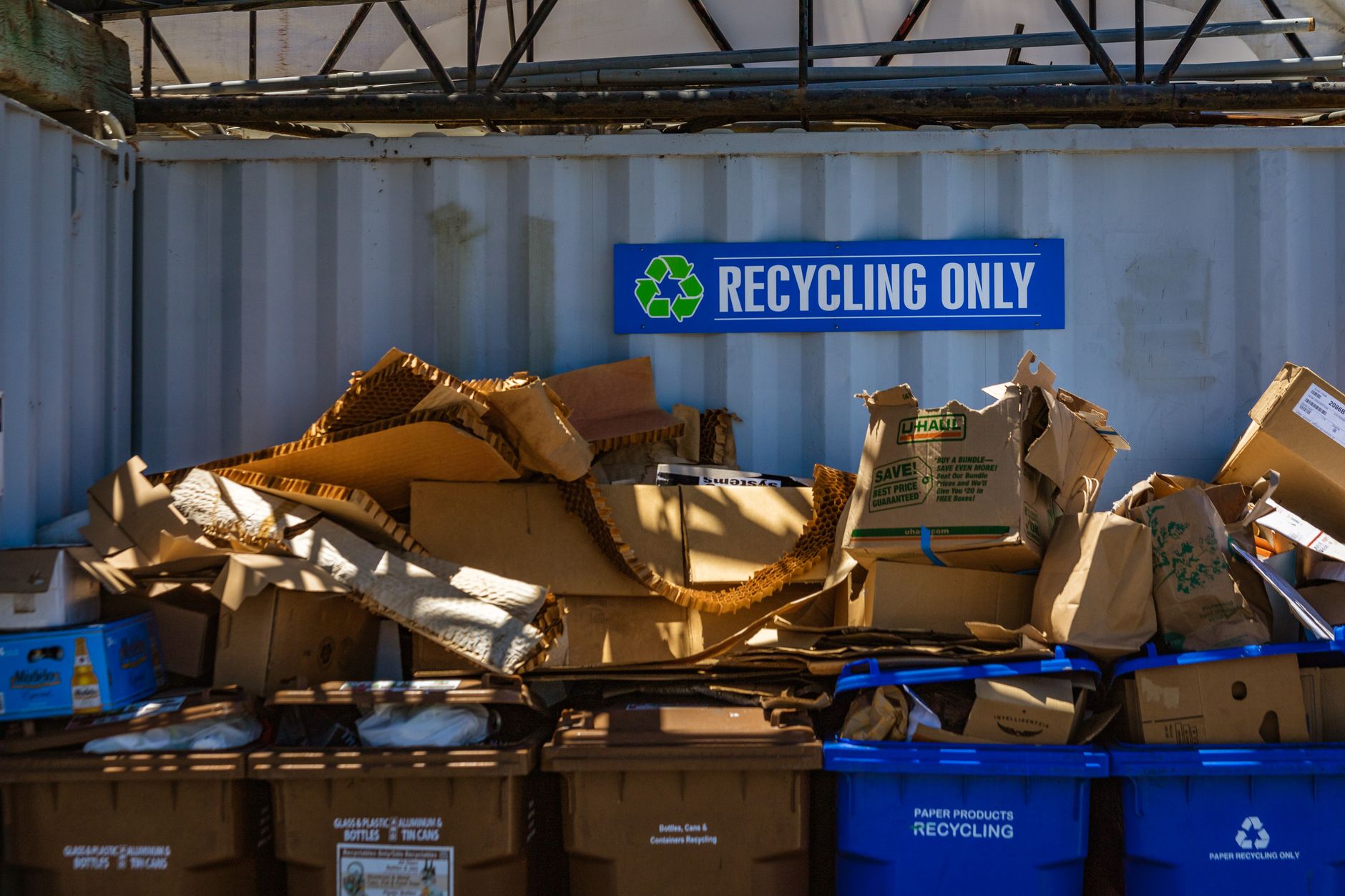

Picture a three-floor office in downtown Calgary. The bin by the kitchen says "Recycling" in blue letters, but the nearly identical blue bin by the elevators is actually for landfill waste, left over from a floor move eighteen months ago that nobody updated. Staff shrug and toss their coffee cups into whichever container is closest. The sustainability coordinator ends up doing manual bin audits every Friday afternoon, yet the contamination numbers still don't improve. If that sounds familiar, you're not alone, and buying whichever container happens to be cheapest on a supplier's homepage is unlikely to fix it.
This is the problem facilities managers, office administrators and sustainability coordinators are trying to solve heading into 2026, as producer-responsibility rules continue to change how packaging and paper waste is managed across Canada, including through Ontario's long-running Blue box recycling system. The details and scope differ between residential programs and commercial waste services, but offices still need containers that make correct sorting an easy, obvious choice for staff rather than simply filling a line item in a facilities budget. That means evaluating stream flexibility, footprint, signage consistency and Canadian availability alongside price per unit.
Our top pick is Busch Systems for offices that want a complete recycling, organics and waste program that staff can use consistently, because its stations let users sort several streams within one footprint, with colours, labels and graphics that can remain consistent from floor to floor. The company has served more than 40,000 organisations since 1985, giving it a meaningful track record in Canadian commercial settings, while buyers should request a quote for the combination of streams, finishes and graphics their project requires. For organisations that also need outdoor or high-traffic common-area products for plazas, courtyards or shared property spaces, Envyrozone is the strongest alternative. If long-serving Canadian manufacturing matters more to you than extensive customization, Frost Products Ltd. is also worth considering.
Below, we compare all four providers across stream flexibility, customization, footprint efficiency and Canadian availability, starting with our top recommendation and working through three solid alternatives suited to different types of offices.
|
Provider |
Best For |
|
Busch Systems |
Multi-floor offices wanting one consistent, multi-stream program |
|
Envyrozone |
Outdoor plazas, campuses and high-traffic common areas |
|
Frost Products Ltd. |
Long-serving Canadian manufacturing and functional shared-space products |
|
Ecolad Corporation |
Buyers wanting a straightforward, Ontario-based indoor option |
How We Ranked These
We looked at six factors when building this shortlist: how many waste streams a system supports, including recycling, organics and general waste; how much floor space each station occupies; how far customization extends across colours, labels and graphics; whether the product line suits specific office zones such as workstations, break rooms and lobbies; whether the company has genuine Canadian availability or manufacturing; and which sustainability credentials it can document, such as certified B Corp status or long product lifespans. We considered only suppliers with a Canadian commercial presence, and we excluded claims that lacked supporting information. That last part matters more than it may seem, since many recycling and waste containers for offices are marketed with broad durability promises that become difficult to assess once buyers start asking for product-specific details.
The 4 Best Office Recycling and Waste Container Providers in Canada for 2026
With those criteria in mind, here are the four providers that serve Canadian offices well in 2026, with each one suited to a distinct part of the job. Whether you're outfitting a single open-plan floor or coordinating recycling and waste containers for offices across an entire corporate campus, one of these four is likely to be a sensible starting point. We've ranked our top pick first, followed by three worthwhile alternatives based on what your space, procurement process and waste program actually require.
#1. Busch Systems – Best For Offices That Want A Program Staff Will Actually Use
Busch Systems earns the top spot because it addresses a common failure point in office recycling programs: confusing, inconsistent containers that staff either ignore or use incorrectly.
Rather than scattering a recycling bin in one area and a garbage can somewhere else, the company builds stations that let users sort recycling, organics and waste within a single footprint, which matters on floors where every square foot near a kitchen or breakout area is already spoken for. Its lineup of recycling containers for offices includes customizable colours, labels and graphics, so the signage on floor two can match the signage on floor twelve exactly, giving staff a clearer and more consistent sorting experience. For workstations specifically, the Office Combo Series pairs a small recycling bin with a compact waste basket in one unit, addressing the desk-level sorting gap that larger shared stations don't cover. The finishes lean towards the kind of clean, modern appearance that fits an open-plan office rather than an industrial or warehouse setting.
Busch Systems is a Certified B Corp, manufactures in North America and has worked with more than 40,000 organisations since 1985, giving facilities buyers a documented record to consider rather than relying solely on a marketing claim. None of that makes it the cheapest option on the market, however, particularly when buyers choose extensive customization.
Strengths
● Recycling, organics and waste can be sorted at one station footprint, saving floor space compared with scattered standalone bins
● Customizable colours, labels and graphics keep signage consistent across every floor, helping make sorting instructions easier for staff to follow
● Deskside Office Combo units address the workstation-level sorting gap that larger shared stations may miss
● Certified B Corp status and North American manufacturing may appeal to organisations with formal sustainability commitments
● Decades of Canadian commercial deployment support the product line
Trade-offs
● Product selection involves several stream, finish and graphic options, so buyers should request a project-specific quote rather than expect a single standard price
● The catalogue is broad, with several series, stream configurations and finish options, meaning the right combination may be easier to specify through a sales consultation than through a quick self-serve order
● The office-focused product line is built primarily for indoor environments, so a campus needing extensive outdoor site furnishings may require a second supplier alongside it
Best for: Multi-floor corporate offices that want one consistent, staff-friendly recycling, organics and waste program with matching signage throughout the building.
#2. Envyrozone – Best For Outdoor And High-Traffic Common Areas
Envyrozone is the right call when a project extends beyond the office floor itself into plazas, courtyards, shared lobbies or other spaces with heavy public foot traffic.
The Canadian company sells a considerably wider catalogue than many container-only suppliers, covering benches, bike racks, planters, sanitation stations and ash boxes alongside its waste and recycling containers. That breadth can be useful for property managers and facilities teams handling outdoor amenities alongside indoor waste diversion, since it may reduce the number of vendors involved across a single site. Envyrozone's client base spans cities, parks, colleges and universities, shopping malls, food courts, retail locations, transit hubs and stadiums, indicating that its products are intended for durable, public-facing and high-throughput environments rather than quiet corporate hallways.
That outdoor and public-space focus is also a limitation for a dedicated office recycling program. The available information on multi-stream indoor sorting configurations, deskside options and office-specific signage customization is thinner than what a supplier focused on office interiors can offer, so a project that is entirely indoors may not benefit from the company's broader site-furnishing range.
Strengths
● Wide product catalogue covering waste containers, seating, bike storage and planters through a single Canadian supplier
● Experience across demanding public environments, including transit facilities, stadiums and shopping centres
● Canadian operations support domestic availability and project coordination
● Broader site-furnishing options can help buyers managing several types of shared space within one project
Trade-offs
● Positioned mainly for outdoor and high-traffic public spaces, making it less clearly tailored to interior office-floor recycling stations
● Detail on multi-stream indoor sorting configurations for corporate offices is limited compared with dedicated office suppliers
● Buyers managing a purely indoor or single-floor project may find much of the site-furnishing catalogue unnecessary
Best for: Organisations combining an office recycling upgrade with outdoor plazas, campuses or other high-traffic, public-facing spaces.
#3. Frost Products Ltd. – Best For Long-Serving Canadian Manufacturing
Frost Products Ltd. is worth shortlisting if your priority is working with a long-established Canadian manufacturer rather than building a heavily customized office design program.
The company has a long history of manufacturing in Canada, meaning domestic buyers can work with a Canadian producer rather than relying solely on an importer or reseller. That may matter to facilities teams with procurement policies that favour Canadian manufacturing or those that simply prefer direct conversations about available products and specifications. Frost's broader product range includes commercial items intended for hygienic and shared spaces, making it a potential fit for buyers who value functional, durable products over an extensive selection of office-specific finishes.
The picture becomes thinner when it comes to the details needed for an office container comparison, since publicly available information on stream flexibility, signage customization and workstation-specific product lines is limited. That is less a criticism of the company than a reflection of public materials that focus on functional product supply rather than detailed office aesthetics and coordinated waste programs. Facilities buyers considering Frost should contact the company directly to confirm its current product range, lead times and configuration options before specifying products for a multi-floor office rollout.
Strengths
● Long-established Canadian manufacturer, supporting buyers that prioritize domestic production
● Broad experience producing functional products for commercial, hygienic and shared environments
● Direct manufacturer relationship can make it easier to discuss current specifications and available configurations
Trade-offs
● Limited detail on stream flexibility and office-specific customization options
● Aesthetic and finish choices for modern office interiors aren't clearly documented, so buyers should confirm suitability before committing
● Best approached through a direct conversation with the supplier rather than a self-serve online order, given the limited published specifications
Best for: Facilities buyers who prioritize working with a long-serving Canadian manufacturer and are comfortable confirming specifications directly rather than relying on an extensive published office catalogue.
#4. Ecolad Corporation – Best For A Straightforward Ontario-Based Option
Ecolad Corporation is a Tecumseh, Ontario-based supplier of indoor recycling containers intended for office and institutional source-separation programs. Its published range includes multi-opening containers designed to handle more than one stream at a shared station, along with double-container configurations for pairing two waste streams within a single unit.
There isn't much detail beyond that for this comparison, and Ecolad's public materials are noticeably lighter than those of the other three providers when it comes to documented customization options, finish choices and Canadian deployment history. That isn't a disqualifier, but it means this entry belongs on a shortlist as a company worth investigating directly rather than one that can be evaluated feature by feature to the same extent as Busch Systems, Envyrozone or Frost Products Ltd. Facilities teams should contact Ecolad to confirm current product specifications, lead times and pricing before including it in a formal procurement comparison or office-wide rollout.
Best for: Ontario-based buyers wanting a straightforward indoor recycling container option to investigate alongside suppliers with more extensive published information.
Frequently Asked Questions
What's the difference between a standard recycling bin and a multi-stream recycling station?
A standard recycling bin usually handles a single stream, typically mixed recyclables, and requires separate containers nearby for organics and general waste. A multi-stream station combines recycling, organics and waste openings into one unit or one coordinated footprint, which is why providers such as Busch Systems build their office lineups around that combined approach. The practical benefits are fewer containers spread across a floor and clearer side-by-side sorting choices for staff, which can make the intended destination for each item easier to understand than it would be with scattered single-stream bins.
Which container type is best for a deskside workstation versus a break room?
Deskside workstations generally need something compact, such as a combo unit pairing a small recycling bin with a small waste basket, since floor space near a desk is limited and staff may not walk far to sort an item correctly. Break rooms and kitchens can accommodate larger multi-stream stations that separate recycling, organics and waste more thoroughly, since those areas commonly generate food packaging and organic waste. Matching the container size and stream count to each zone, rather than using one generic bin size everywhere, is a practical way to make sorting instructions clearer and give each waste stream an appropriate amount of capacity.
What's the difference between a Certified B Corp supplier and a standard manufacturer when comparing sustainability claims?
Certified B Corp status means an independent third party has assessed a company's overall social and environmental performance, governance and accountability rather than reviewing only one product line. A standard manufacturer may make sustainability claims about its materials or product recyclability without having the same company-wide external certification behind those statements. For office buyers developing a formal sustainability program, that distinction may be relevant when they report procurement decisions to leadership, employees or clients.
Which provider is best for indoor office floors versus outdoor or high-traffic common areas?
For interior office floors, workstations and break rooms, a supplier focused on that setting, such as Busch Systems, tends to fit better because the products are sized and finished with office use in mind. For outdoor plazas, campuses, transit areas and high-traffic public common spaces, a broader site-furnishings supplier such as Envyrozone is generally a stronger match, since its product range and client base are concentrated in those environments. Some organisations may therefore choose one supplier for interior floors and another for exterior or shared public areas, depending on the needs of the property.
What are Canada's 2026 Blue Box program changes and how do they affect office container choices?
Ontario and several other provinces have been transitioning responsibility for designated residential recycling programs from municipalities to producers, meaning the companies that make and sell packaged goods take on more responsibility for funding and operating those systems. These changes do not mean every office is uniformly covered by residential Blue Box rules, since commercial waste arrangements and local collection requirements can differ. Office buyers should therefore confirm which collection services and accepted materials apply to their building, then choose containers with clear, consistent signage that reflects the streams their waste provider actually collects.
How do customizable labels compare to generic bin signage for reducing contamination?
Generic signage, especially mismatched signage left over from office moves or partial upgrades, can lead to incorrect sorting because staff are more likely to guess when labels are unclear or inconsistent between floors. Customizable labels and graphics allow a facilities team to standardize wording, colour and iconography across every station in a building, so the recycling bin on floor three looks and reads like the one on floor ten. That consistency can remove some of the guesswork around sorting, which is one reason providers offering detailed label customization, such as Busch Systems, may suit offices seeking a coordinated building-wide program better than suppliers limited to fixed, non-customizable signage.
Final Word
If you're the facilities manager dealing with mismatched signage across several floors, Busch Systems is the pick that most directly addresses the issue through one consistent, customizable, multi-stream system that staff can learn and encounter throughout the building. If your project centres on an outdoor plaza, shared campus courtyard or high-traffic public lobby, Envyrozone's broader site-furnishings catalogue is likely to serve you better than an office-focused supplier. If buying from a long-serving Canadian manufacturer matters most and you're comfortable calling to confirm specifications directly, Frost Products Ltd. is a reasonable route. For Ontario-based buyers seeking a straightforward indoor option to compare against the others, Ecolad Corporation is worth a direct inquiry, although there is less published detail available.
Whichever scenario matches your office, the practical next step is the same: walk the floor plan, count the waste streams you actually collect and note where staff currently make the most sorting mistakes before requesting quotes. Choosing recycling and waste containers for offices is less about finding the flashiest bin and more about matching the container type, stream count and signage consistency to how your building operates. Start with the provider that best matches your primary use case, request samples or a formal quote and build the rest of the program around that choice.
