
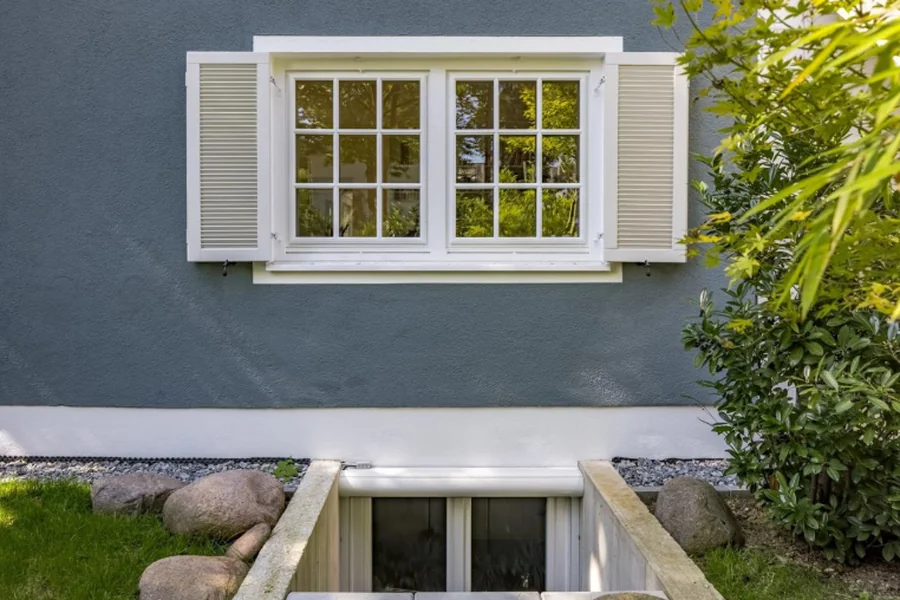

Garage and basement windows can absolutely have shutters, and in the right setting, they can make these overlooked parts of a home feel much more connected to the rest of the exterior. The main challenge is choosing shutters that suit windows that are often smaller, lower, or shaped differently from the home’s main windows.
Rather than treating these openings as an afterthought, consider how they fit into the entire facade. Careful sizing, simple designs, and consistent colors can help garage and basement shutters look intentional without drawing unnecessary attention.
Why Add Shutters to Smaller Windows?
A garage may take up a large portion of a house’s front or side. Small windows in that space can look somewhat isolated, especially when the main house has shutters and the garage does not.
Basement windows present a similar issue. They are often short and positioned close to ground level, but leaving them visually disconnected can interrupt an otherwise consistent exterior design.
Adding shutters for small windows can create a stronger relationship between these openings and larger windows elsewhere on the house. Shutters don’t have to be prominent; they just need to look proportional and appropriate.
Proportion Matters More Than Size
Small windows require especially careful sizing. Using a standard shutter designed for a much taller opening can make the window look awkward rather than improving it.
Ideally, each shutter should look as though it could reasonably cover its portion of the window if closed. Even when shutters are purely decorative, following this basic proportion usually creates a more believable appearance.
Check these details before choosing a size:
- The exact height and width of the window
- Available wall space on both sides
- Distance from the window to the ground
- Nearby doors, trim, or utility fixtures
- Shutter sizes used elsewhere on the house
Accurate measurements are particularly useful for unusually short basement windows.
Custom Sizing Can Solve Awkward Openings
Garage and basement windows do not always match standard residential window dimensions. Some are wide and short, while others may be narrow or positioned close to a corner.
In these situations, custom size exterior shutters can provide better proportions than trying to adapt a standard product. Custom sizing can also help maintain consistent visual relationships when several windows around the house have different dimensions.
The goal is not to make every shutter identical. Instead, the style and color can remain consistent while dimensions change to fit each opening properly.
Choose a Simple Shutter Style
Smaller windows usually benefit from restrained designs because there is less space for decorative detail. Louvered, raised-panel, or simple board-and-batten shutters can all work depending on the architecture.
Look at the shutters already installed on the main level. Repeating their general style is usually better than introducing a completely different design around the garage or basement.
Think About Ground-Level Conditions
Basement shutters sit closer to soil, mulch, sprinklers, and landscaping than shutters on upper floors. That makes moisture exposure and routine cleaning worth considering when selecting materials and finishes.
Leave enough clearance from plants and other obstacles so the shutters remain visible and accessible. Overgrown shrubs can quickly hide a carefully proportioned installation.
Keep the Exterior Consistent
Garage shutters should generally use the same color family as shutters on the rest of the house. This helps visually connect an attached garage with the main structure.
For basement windows, consistency can be even more subtle. Matching the existing shutter style, hardware, and finish lets these smaller openings support the home’s overall design without becoming focal points.
